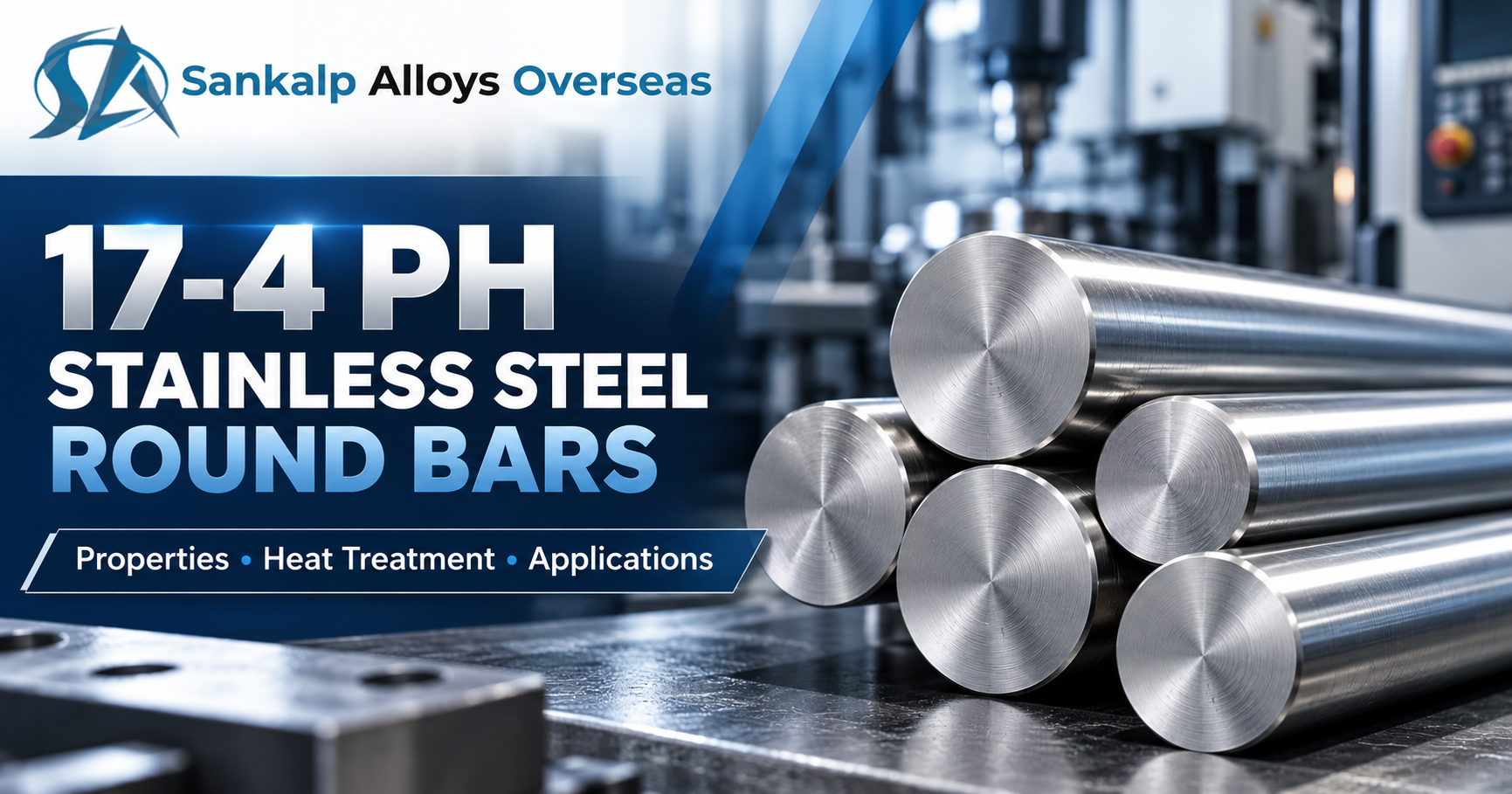
17-4 PH stainless steel round bars are used when a component needs a combination of mechanical strength, hardness and corrosion resistance. The designation 17-4 PH refers to a precipitation-hardening stainless steel, commonly identified as UNS S17400 and Type 630. Its properties depend strongly on the supplied heat-treatment condition.
What is 17-4 PH stainless steel?
The name “17-4” refers approximately to its chromium and nickel content; copper contributes to precipitation hardening. The grade is commonly used for machined parts such as shafts, valve components, pump components and aerospace hardware where the design calls for this material. It is not interchangeable with austenitic grades such as 304 or 316 merely because all are called stainless steel.
Key properties of 17-4 PH round bars
- High strength potential: Age hardening can produce substantial increases in strength and hardness compared with the solution-treated condition.
- Machinability: Bars can be machined into precision components, with machining approach dependent on condition and tooling.
- Corrosion resistance: Useful in many industrial environments, but suitability must be evaluated for chlorides, temperature, crevices and the chosen condition.
- Magnetic response: 17-4 PH is generally magnetic because of its martensitic structure.
- Heat-treatment sensitivity: H900 and H1150 are not simply alternative labels for the same properties.
17-4 PH heat treatment: Condition A, H900, H1025 and H1150
17-4 PH gains its distinctive property combinations through solution treatment followed by precipitation-hardening (aging). Aging condition labels describe different treatment schedules, but exact requirements must be taken from the governing specification and the material certificate.
| Condition | General characteristics | Buyer consideration |
|---|---|---|
| Condition A | Solution-treated starting condition; not equivalent to an age-hardened supply | Confirm whether further aging is required by the drawing |
| H900 | Commonly selected where very high strength and hardness are priorities | Assess toughness, corrosion conditions and engineering requirements |
| H1025 | Intermediate balance of mechanical properties | Verify certified strength, hardness and impact requirements |
| H1150 | Typically lower strength and hardness than H900, with different toughness characteristics | Check whether this condition meets design loads and service conditions |
These descriptions are qualitative, not guaranteed numerical values. Heat-treatment temperatures, times and mechanical-property minima must be verified against the applicable specification, bar size and material test certificate.
17-4 PH vs 304 and 316 stainless steel
17-4 PH is often considered for high-strength machined components, while 304 and 316 are austenitic stainless steels selected for other combinations of fabrication and corrosion performance. Grade 316 is often considered for certain chloride-containing environments, but no grade is universally resistant to corrosion. Substitution should be approved by the responsible engineer.
Typical applications of 17-4 PH round bars
- Precision-machined shafts and couplings
- Valve stems, fittings and pump components
- Aerospace and mechanical hardware specified to the grade
- Industrial fastener and equipment components where strength requirements justify the alloy
- Oil, gas and process-industry components when the specification and environment permit
Specifications and documentation buyers should check
Round bars are commonly ordered to standards such as ASTM A564/A564M, where applicable. Other project or industry specifications may govern. Always confirm the exact standard edition, heat-treatment condition, dimensions, tolerances, inspection and certification requirements rather than relying only on the grade name.
Quotation checklist
- Material designation: 17-4 PH / Type 630 / UNS S17400
- Product form: round bar, and required diameter and cut length
- Condition: Condition A, H900, H1025, H1150 or another specified condition
- Governing ASTM/ASME, aerospace or customer specification
- Quantity, dimensional tolerance, finish and delivery location
- Material test certificate, traceability and any additional testing requirements
How to choose the right condition
Start with the engineering drawing and service requirements. If strength and hardness dominate, a higher-strength aging condition may be relevant; if toughness and other service factors dominate, another condition may be more appropriate. Compare certified mechanical properties for the actual bar size and condition, then assess corrosion exposure, machining and any post-processing. Do not choose an aging condition from a blog alone.
Explore 17-4 PH round bars at Sankalp Alloys Overseas
See our 17-4 PH stainless steel round bars product page for product enquiries. You can also contact Sankalp Alloys Overseas with your grade, condition, size, specification and quantity for an availability and quotation discussion.
Frequently asked questions
What does 17-4 PH mean?
It identifies a precipitation-hardening stainless steel commonly designated UNS S17400 or Type 630. The “17-4” name approximately reflects chromium and nickel content.
Is 17-4 PH the same as stainless steel 630?
Type 630 is a common designation for 17-4 PH stainless steel. The applicable standard and required heat-treatment condition must still be specified.
What is the difference between H900 and H1150?
They are different precipitation-hardening conditions. H900 is generally associated with higher strength and hardness, while H1150 gives a different balance of properties. Certified values and project requirements control the selection.
Can 17-4 PH round bars be used for shafts?
Yes, the grade is used for certain shafts and precision-machined components, subject to the required strength, fatigue, corrosion and dimensional specifications.
Is 17-4 PH corrosion resistant?
It offers useful corrosion resistance in many services, but performance depends on the environment, heat-treatment condition, surface condition and component design.
What details should I provide for a quotation?
Provide UNS S17400 / 17-4 PH, diameter, length, condition, standard, quantity, tolerances and certification requirements.
Need 17-4 PH stainless steel round bars?
Send your technical requirements to Sankalp Alloys Overseas. Specify the heat-treatment condition and material standard so the correct supply option can be checked.
Technical note: This guide provides general information, not guaranteed design properties or a substitute for material certification and engineering review.