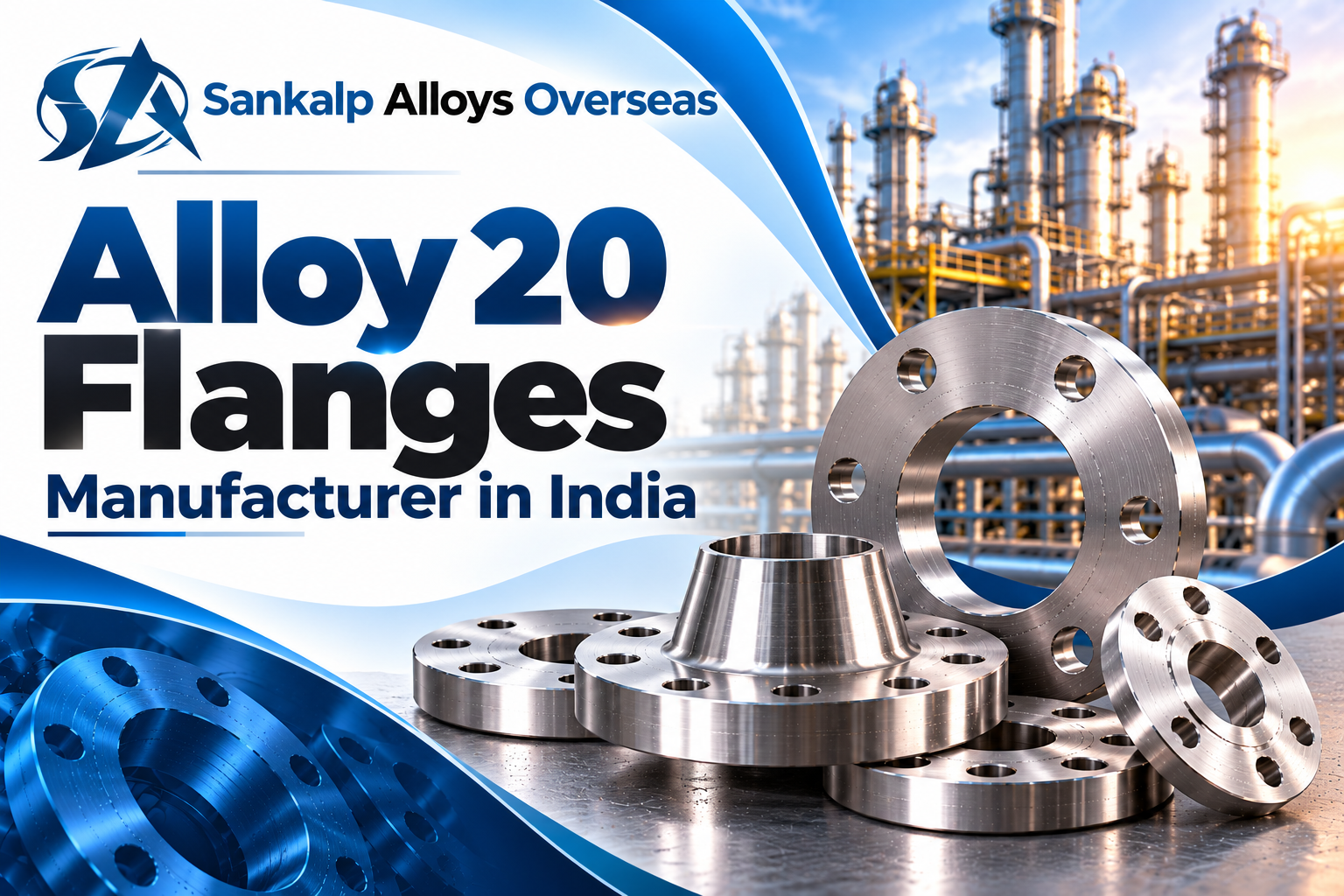
If you are searching for an Alloy 20 Flanges Manufacturer in India, start with the process conditions rather than the flange price alone. Alloy 20 (UNS N08020) is selected for certain acid-handling and chemical-processing systems, especially where resistance to sulphuric acid is important. SankalPalloys can be approached with a detailed flange enquiry covering grade, size, pressure class, facing, drawings and documentation.
What is an Alloy 20 flange, and why is it used?
An Alloy 20 flange connects pipework, valves, pumps or equipment in a piping system where UNS N08020 has been specified for corrosion resistance. The alloy contains nickel, iron and chromium, with copper and molybdenum that contribute to performance in several acid environments. It is particularly associated with sulphuric-acid handling, but actual suitability depends on concentration, temperature and contamination.
Is Alloy 20 the same as Carpenter 20 or UNS N08020?
UNS N08020 is the standard material designation. Alloy 20, Carpenter 20 and 20Cb-3 are names buyers may encounter; W.Nr. 2.4660 is another common identification. For procurement, write the UNS number and required material specification rather than relying only on a trade name.
Sticky Q&A — What should be confirmed first? Confirm the fluid and design conditions, then match material grade, flange type, size, class, facing and bore to the mating connection. Correct alloy chemistry does not compensate for incorrect drilling or gasket geometry.
Alloy 20 chemical composition and material identification
The figures below are published composition ranges and limits for UNS N08020, in weight percent. These are reference values, not a substitute for checking the applicable edition of the purchase specification or the supplied heat's material test certificate.
| Element | Published range / maximum (% by weight) |
|---|---|
| Nickel (Ni) | 32.0–38.0 |
| Chromium (Cr) | 19.0–21.0 |
| Iron (Fe) | Balance |
| Copper (Cu) | 3.0–4.0 |
| Molybdenum (Mo) | 2.0–3.0 |
| Niobium + tantalum (Nb + Ta) | Minimum related to carbon content; 1.0 maximum |
| Carbon (C) | 0.07 maximum |
| Manganese (Mn) | 2.0 maximum |
Buyer tip: Ask for UNS N08020 and heat-number traceability on the purchase order. Do not approve a substitute such as 316L, 904L or another nickel alloy solely on the basis of a general corrosion-resistance description; any change needs engineering review.
Types of Alloy 20 flanges and selection details
The suitable flange configuration depends on the piping design, welding method, maintenance plan and available manufacturing route. Confirm the requested type and dimensions on the drawing rather than assuming every configuration is readily available.
| Flange type | Typical connection | Detail to confirm |
|---|---|---|
| Weld neck | Butt-welded pipe connection | Hub profile, bore, schedule and weld preparation |
| Slip-on | Fillet-welded joint where permitted | Pipe clearance and weld requirements |
| Blind | Closes piping or nozzle ends | Design pressure, thickness and facing |
| Socket weld | Specified small-bore service | Socket depth, pipe fit and installation clearance |
| Threaded | Threaded joint where the code permits | Thread specification and service limitations |
| Lap joint | Backing arrangement with a stub end | Stub-end compatibility, material and geometry |
Which flange face should I choose: RF, FF or RTJ?
RF means raised face, FF flat face and RTJ ring-type joint. The correct face depends on the mating flange and gasket design. Be precise here: a matching bolt circle does not guarantee that two different faces form a safe seal.
Alloy 20 flange pressure classes, dimensions and fit-up
ASME B16.5 specifies dimensional and pressure-temperature requirements for covered pipe flanges and flanged fittings. Common class names include 150, 300, 600, 900, 1500 and 2500; the standard also includes Class 400. Check the actual size range, material listing, rating applicability and governing standard edition. ASME B16.47 may be relevant for certain larger steel flange configurations, subject to project approval and material applicability.
| RFQ field | Why it matters |
|---|---|
| Pressure class | A class name is not a fixed working-pressure value |
| Nominal size (NPS / DN) | Determines connection and drilling geometry |
| Bore / pipe schedule | Must match the specified pipe and weld preparation |
| Facing / gasket | Must suit the mating flange and bolted-joint design |
Sticky Q&A — Does Class 300 mean 300 psi? No. Class 300 is a flange rating designation, not a universal 300 psi operating limit. The allowable service pressure depends on material group, temperature, standard and joint design.
Alloy 20 flange standards, material testing and documentation
Which standard should a buyer specify for Alloy 20 forged flanges?
- UNS N08020: Material designation for Alloy 20.
- ASTM B462: Standard covering specified forged or rolled nickel-alloy pipe flanges, including UNS N08020, with material and testing requirements.
- ASME SB-462: Consider when the construction code or project explicitly calls for the ASME-adopted specification.
- ASME B16.5: Flange dimensions and ratings where its scope and material/rating requirements apply.
- Project drawing and piping specification: Defines bore, facing, tolerances, weld details and any additional inspection.
What documents should come with Alloy 20 flanges?
Ask for the agreed material test certificate (MTC), heat traceability and dimensional checks. If positive material identification (PMI), non-destructive examination (NDT), third-party inspection or a particular certificate format is needed, state it clearly in the enquiry and purchase order. It is much harder to add an inspection hold point after material has been dispatched.
Practical point: For replacement flanges, request the existing flange's exact standard and measured dimensions. An equipment photo is helpful, but it cannot reliably establish a bolt-hole pattern or raised-face height.
Where are Alloy 20 flanges used in industry?
Alloy 20 is commonly evaluated for sulphuric-acid processing, phosphoric-acid handling, chemical plants, pickling-related systems, processing equipment and selected heat-exchanger or tank connections. The copper and molybdenum additions help in particular corrosive media, while high nickel content contributes to resistance in some chloride-bearing conditions.
When is Alloy 20 not automatically the right choice?
Corrosion behaviour changes with acid concentration, temperature, aeration, chloride content and contaminants. Alloy 20 should not be described as universally resistant to every acid or high-temperature service. For mixed chemicals or unusual conditions, check published corrosion data and obtain approval from the process and materials engineer.
Suggested technical-team quote for SankalPalloys (approve before attributing): “The grade is only the starting point. When the customer shares the actual fluid, temperature, mating flange and inspection needs, the flange enquiry becomes much easier to assess correctly.”
How to request an Alloy 20 flange quotation in India
Send one clear request for quotation (RFQ) with these details so technical differences are visible before price comparison:
- Material: Alloy 20 / UNS N08020 and the required forging specification.
- Flange type, quantity and approved drawing if available.
- NPS / DN, pipe schedule, bore and end-preparation details.
- Applicable dimensional standard, pressure class and face (RF, FF or RTJ).
- Required material condition and any project-specific tolerances.
- Design pressure, design temperature and actual process medium.
- Required MTC, heat tracing, PMI, NDT and inspection witness points.
- Delivery location, required date, packaging and quotation terms.
Four common Alloy 20 flange purchasing mistakes
1. Saying only “Alloy 20” without UNS N08020 and a material specification. 2. Omitting bore, facing or mating-flange details. 3. Treating Class 150 or 300 as a fixed pressure value. 4. Comparing prices without matching certificate, inspection and delivery scopes.
Sticky Q&A — How should two quotes be compared? Compare matching material specifications, dimensions, facing, tolerance, inspection requirements, documentation, quantities and terms. If one offer leaves out PMI or delivery, it is not yet a like-for-like comparison.
For a project enquiry, contact SankalPalloys with your drawing or bill of materials and request confirmation of the offered technical and commercial scope.
FAQs about Alloy 20 flanges in India
What is the UNS designation of Alloy 20?
Alloy 20 is designated UNS N08020 and is also associated with W.Nr. 2.4660. Include the UNS number in the material description.
Which ASTM standard covers Alloy 20 forged flanges?
ASTM B462 covers specified forged or rolled nickel-alloy pipe flanges, including UNS N08020. Confirm the edition and any supplementary project requirements.
Which Alloy 20 flange types can I enquire about?
Common connection types include weld neck, slip-on, blind, socket weld, threaded and lap joint. Availability and suitability depend on the required sizes and design standard.
Are Alloy 20 flanges suitable for sulphuric acid?
Alloy 20 was developed for resistance in many sulphuric-acid environments, but suitability depends on concentration, temperature and contaminants. Obtain application-specific engineering approval.
Is Alloy 20 the same as stainless steel 316L?
No. Alloy 20 / UNS N08020 has a different composition, including substantial nickel and copper. Neither material is a direct substitute without corrosion and design assessment.
What is the difference between Class 150 and Class 300 Alloy 20 flanges?
They are different flange class designations with different dimensional and rating requirements. Neither number by itself states the allowed working pressure at every temperature.
Which inspection certificates should I ask for?
Specify an MTC and heat-number traceability if needed. Add PMI, dimensional reports, NDT and third-party witnessing when the project requires them.
What information is required for an Alloy 20 flange price quote?
Share UNS N08020, flange type, quantity, size, bore, pressure class, facing, material and dimensional standards, inspection scope and delivery details.
Discuss your Alloy 20 flange requirements with SankalPalloys
Send your UNS N08020 flange list, drawing, sizes, facing, bore, class, forging standard and inspection requirements. Contact SankalPalloys to discuss the technical scope and request a quotation that reflects your actual application.
Technical references
Consult the current standard editions and published alloy information when preparing a material specification:
- Alloy 20 / UNS N08020 — chemistry and material overview
- ASME B16.5 — Pipe Flanges and Flanged Fittings
- ASTM B462 — Forged or Rolled Nickel Alloy Pipe Flanges
This guide is for general purchasing information. It is not engineering approval or a statement of SankalPalloys stock, production capability, certificates or lead times. Confirm material suitability, specifications and quoted scope before ordering.