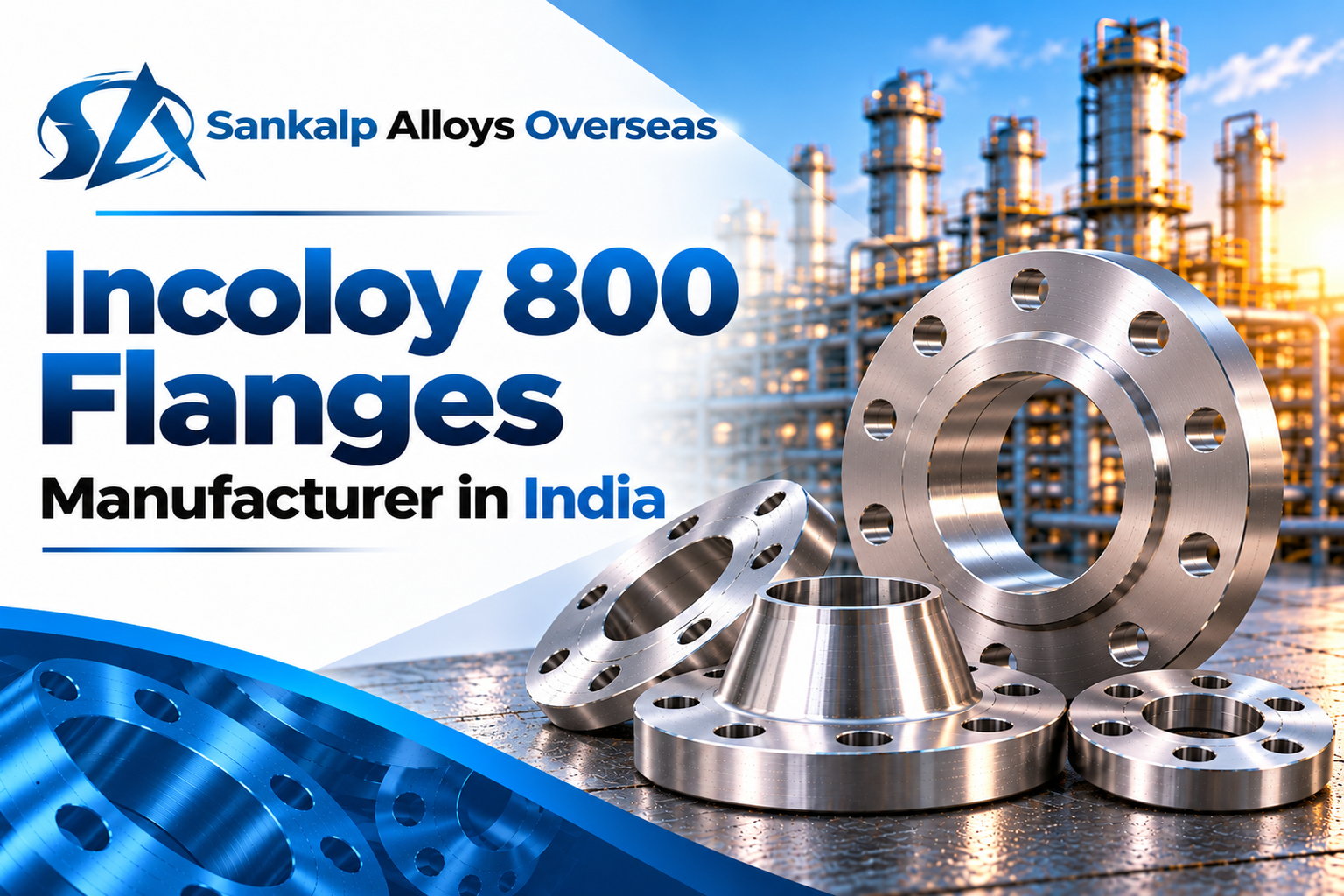
Looking for an Incoloy 800 Flanges Manufacturer in India? Before asking for a price, check where the flange will work: a hot process line, a heat exchanger connection, a petrochemical plant or a corrosion-exposed system. Incoloy 800 (UNS N08800) is a nickel-iron-chromium alloy valued for oxidation resistance, carburization resistance and useful strength in elevated-temperature environments. SankalPalloys welcomes detailed flange enquiries so the required grade, dimensions and inspection scope can be discussed clearly.
What is an Incoloy 800 flange, and why specify it?
An Incoloy 800 flange joins piping, valves or equipment when the piping specification requires UNS N08800. Its nickel-iron-chromium chemistry makes it useful in selected heated and corrosive environments. Compared with choosing a material on corrosion resistance alone, buyers also need to consider thermal cycling, oxidation, weldability and the operating temperature of the complete bolted joint.
Are Incoloy 800, Alloy 800 and UNS N08800 the same?
UNS N08800 is the material designation. Alloy 800 is a generic name; INCOLOY is a registered alloy trade name. W.Nr. 1.4876 is also used in material identification. On a purchase order, UNS N08800 plus the appropriate product specification is clearer than the trade name alone.
Sticky Q&A — What should I confirm before choosing a flange? Start with operating and design temperatures, pressure, process atmosphere, mating flange dimensions and the governing piping code. Then check that the requested grade and manufacturing specification are suitable.
Incoloy 800 chemical composition and material identification
These are commonly published UNS N08800 nominal specification ranges and maximums by weight. The actual chemistry must be checked against the ordered specification edition and the material test certificate (MTC). A composition table is not proof that any particular supplied flange complies.
| Element | Published range / maximum (% by weight) |
|---|---|
| Nickel (Ni) | 30.0–35.0 |
| Chromium (Cr) | 19.0–23.0 |
| Iron (Fe) | Balance (typically 39.5 minimum) |
| Aluminium (Al) | 0.15–0.60 |
| Titanium (Ti) | 0.15–0.60 |
| Carbon (C) | 0.10 maximum |
| Manganese (Mn) | 1.50 maximum |
| Silicon (Si) | 1.00 maximum |
Buyer tip: Do not accept an offer marked only “800 series.” Ask whether the heat is N08800, N08810 or N08811, and check the heat number against the MTC. These grades have important differences in carbon control, processing and elevated-temperature properties.
Types of Incoloy 800 flanges and connection details
Common flange configurations can be discussed for an Incoloy 800 project, but the required type must be compatible with the piping code and manufacturing route. A catalogue illustration is not enough to establish suitability or availability in UNS N08800.
| Flange type | Typical connection | Detail to confirm |
|---|---|---|
| Weld neck | Butt-weld connection to piping | Bore, pipe schedule, weld prep and hub geometry |
| Slip-on | Fillet-weld connection where permitted | Weld arrangement and thermal-service restrictions |
| Blind | Closure for a pipe or equipment opening | Required thickness, face and design conditions |
| Socket weld | Specified small-bore piping | Socket dimensions, fit-up and service limitations |
| Threaded | Non-welded joint where permitted | Thread standard and temperature/service restrictions |
| Lap joint | Loose backing flange with stub end | Stub-end alloy, facing and matching dimensions |
Should I specify raised face, flat face or RTJ?
RF is raised face, FF is flat face and RTJ is ring-type joint. Select the facing from the mating equipment and gasket design, not just from what is quoted first. For hot services, gasket material and bolting requirements matter as much as the flange face.
Incoloy 800 flange pressure classes, sizes and temperature ratings
ASME B16.5 includes flange class designations 150, 300, 400, 600, 900, 1500 and 2500 within its scope. However, a dimensional class does not establish a usable pressure-temperature rating for every alloy. Confirm whether UNS N08800 has an applicable listed material group and rating in the project’s adopted standard, or whether an engineered, code-compliant design is needed. Do not assume that a class designation alone approves the flange for hot service.
| RFQ field | Why it matters |
|---|---|
| Pressure class / design basis | Must be supported by a valid material-specific rating or approved calculation |
| Nominal size (NPS / DN) | Controls drilling and mating connection geometry |
| Bore / pipe schedule | Must match the pipe and weld end preparation |
| Design temperature / gasket | Controls material, bolting, sealing and joint suitability |
Sticky Q&A — Does Class 300 mean the flange can handle 300 psi? No. Class 300 is a designation, not a fixed pressure limit. An applicable material-specific pressure-temperature rating and the governing code must be checked.
Incoloy 800 flange standards, testing and required documents
Which specification applies to UNS N08800 forgings?
- UNS N08800: Grade designation for Alloy 800.
- ASTM B564: Nickel alloy forging specification that includes UNS N08800; confirm the current edition and ordered product requirements.
- ASME SB-564: ASME-adopted material specification where the construction code requires it.
- ASME B16.5: Dimensional and pressure-temperature framework where the relevant size, material and rating provisions apply.
- Approved project specification: Establishes bore, facing, heat treatment condition, tolerances and any additional examination.
What documents should I request with Incoloy 800 flanges?
State the expected MTC, heat-number traceability and dimensional inspection scope when requesting a quote. Ask about PMI (positive material identification), non-destructive testing, mechanical test results or third-party inspection only where required by the project. The documents and tests included should be agreed before ordering.
Practical point: For a replacement flange, share an existing drawing or measurable flange details. Photos help identify the general type, but they do not verify the drilling pattern, bore, face height or material grade.
Where are Incoloy 800 flanges used, and what are the limits?
Incoloy 800 is considered in petrochemical processing, furnace-associated piping, heat-treatment equipment, heat exchanger connections and certain chemical process systems. Its resistance to oxidation and carburization is useful in selected hot environments. The alloy also performs in some aqueous corrosive services, but resistance must be checked against the actual medium.
When should an engineer consider Incoloy 800H or 800HT instead?
800 (N08800), 800H (N08810) and 800HT (N08811) are not interchangeable specifications. ASTM B564 describes N08800 as normally used up to about 593°C (1100°F), while 800H and 800HT are associated with higher-temperature creep and rupture requirements. This is a material-selection distinction, not a blanket permitted operating-temperature rating for a flange assembly. Obtain engineering review of the complete joint and design code.
Proposed insight for SankalPalloys technical-team review (not an attributed quotation): “A flange enquiry that says only ‘Incoloy 800, Class 300’ still leaves important gaps. Temperature, bore, facing and the actual material standard are often what decide whether the item fits the project.”
How to request an Incoloy 800 flange quotation in India
Send a complete RFQ so quotations can be compared on the same technical basis:
- Material grade: Incoloy 800 / UNS N08800 (or an explicitly approved alternative).
- Flange type, quantity and approved drawing or item reference.
- NPS / DN, bore, pipe schedule and weld-end preparation.
- Dimensional standard, class or design basis, and flange facing.
- Required ASTM/ASME forging specification and material condition.
- Operating/design pressure, temperature, process medium and thermal cycling.
- MTC, heat traceability, PMI, NDT and inspection requirements.
- Delivery location, required date, packing and quotation terms.
Four common Incoloy 800 flange buying mistakes
1. Confusing N08800 with 800H or 800HT. 2. Specifying “Class 300” without verifying a valid material-specific rating. 3. Forgetting the bore, mating face or gasket requirements. 4. Comparing quotes without checking what certificates, inspections and delivery are included.
Sticky Q&A — How do I compare two quotations fairly? Match the grade, forging specification, dimensions, design basis, inspection scope and delivery conditions. A lower price with a different material or missing testing is not a like-for-like offer.
For your next project, contact SankalPalloys with the bill of materials or drawing and ask for the proposed material and commercial scope to be confirmed.
FAQs about Incoloy 800 flanges in India
What is the UNS number for Incoloy 800?
UNS N08800 identifies Alloy 800. W.Nr. 1.4876 is another designation sometimes used. Specify the UNS number on your RFQ.
Which ASTM standard covers Incoloy 800 forged flanges?
ASTM B564 includes UNS N08800 nickel alloy forgings. Confirm the current edition and product requirements, alongside the approved flange dimensional standard.
Is Incoloy 800 the same as 800H or 800HT?
No. N08800, N08810 and N08811 have distinct chemistry and processing requirements, especially relevant to elevated-temperature creep service. Do not substitute grades without approval.
Can Incoloy 800 flanges be used at high temperatures?
They may be suitable for specified elevated-temperature applications, but the allowable design temperature depends on material grade, code, pressure, flange design, bolting and gasket. ASTM B564 notes that N08800 is normally used up to around 593°C.
Which Incoloy 800 flange types can I request?
Enquiries may cover weld neck, slip-on, blind, socket weld, threaded and lap joint designs. Confirm manufacturing feasibility, size and code suitability for the specified grade.
Does ASME Class 150 or 300 specify the operating pressure?
No. Class is a rating designation. The actual permissible pressure requires an applicable rating for the material and temperature or an approved design basis.
What certificates and checks should be mentioned in the order?
List the required MTC, heat-number traceability and dimensional checks. Add PMI, NDT or third-party witnessing when called for by your project specification.
What details are needed for an Incoloy 800 flange price enquiry?
Include UNS N08800, flange type, size, bore, class/design basis, facing, forging specification, temperature, quantity, inspections and delivery location.
Discuss Incoloy 800 flange requirements with SankalPalloys
Planning a hot-process or corrosion-related piping project? Share your UNS N08800 flange schedule, drawing, dimensions, design conditions and certification requirements. Contact SankalPalloys to review the enquiry and request a quotation based on your actual specifications.
Technical references
For engineering decisions, consult current editions of standards and published material data:
- Special Metals — nickel alloy handbook and 800-series material information
- ASME B16.5 — Pipe Flanges and Flanged Fittings
- ASTM B564 — Nickel Alloy Forgings
This article is general procurement guidance, not engineering approval or a claim about SankalPalloys inventory, manufacturing capacity, certifications or lead times. Confirm the correct grade, code applicability and quoted scope before ordering.