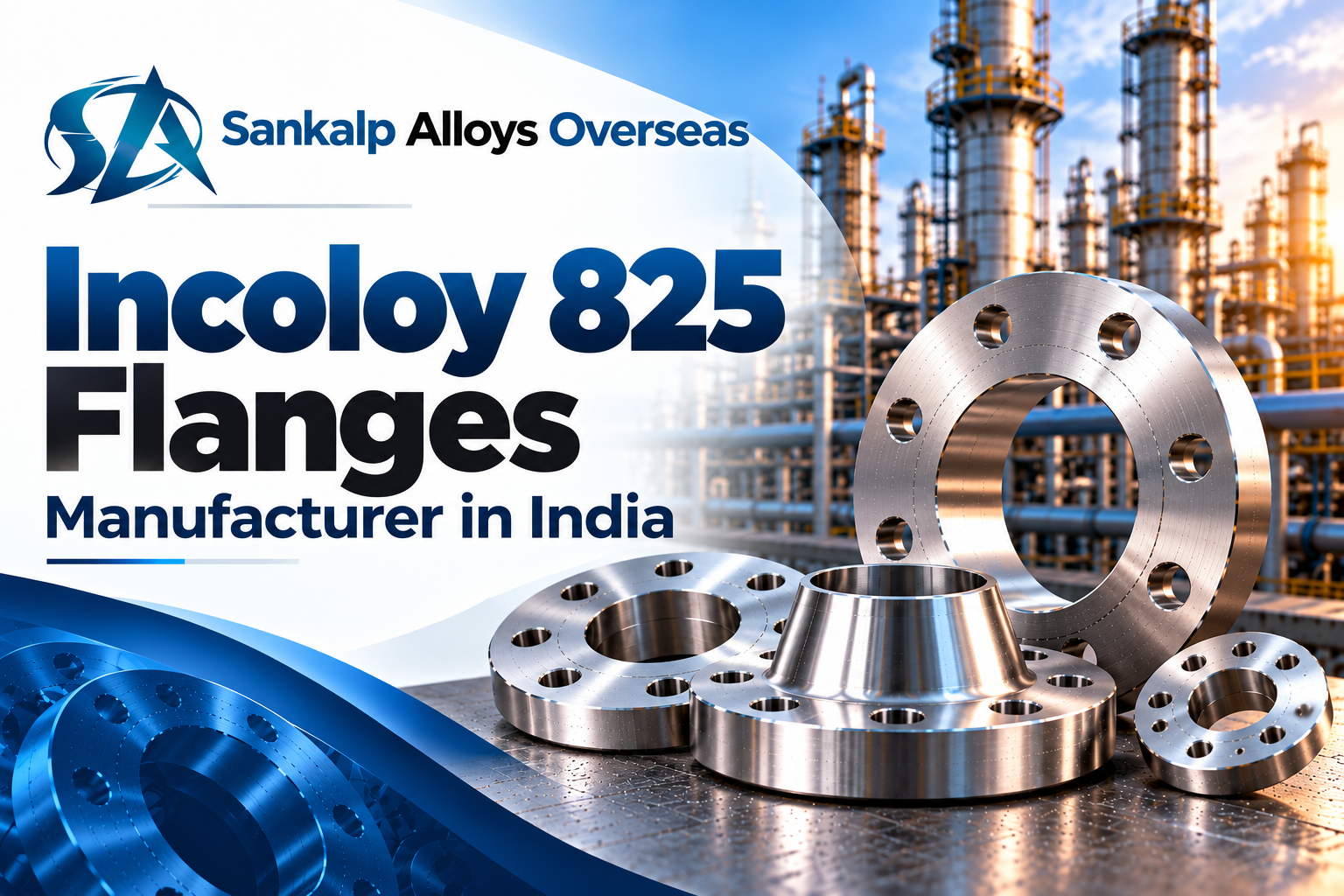
Looking for an Incoloy 825 Flanges Manufacturer in India? Start with the grade and the service conditions, not just a flange size. Incoloy 825 (Alloy 825, UNS N08825) is a nickel-iron-chromium alloy containing molybdenum, copper and titanium. It is considered for piping exposed to certain acids, chlorides and other challenging process environments. SankalPalloys welcomes technical enquiries for Incoloy 825 flanges based on your drawing and specifications.
What are Incoloy 825 flanges (UNS N08825)?
Incoloy 825, also called Alloy 825 or W.Nr. 2.4858, is a titanium-stabilized nickel-iron-chromium alloy. Nickel helps resist chloride-related stress-corrosion cracking; molybdenum and copper contribute to resistance in certain reducing acids; chromium helps in oxidizing environments. Titanium improves resistance to sensitization when the material has been suitably processed.
For an actual flange, the metal grade is only half the conversation. A suitable design also needs the correct connection type, wall/bore, pressure-temperature rating, sealing face and matching bolts and gasket. A corrosion-resistant alloy cannot compensate for a poorly specified joint.
Why do buyers consider Alloy 825 instead of an ordinary stainless grade?
In services involving sulfuric or phosphoric acid and some chloride-containing streams, Alloy 825 may offer useful resistance where a selected stainless steel is unsuitable. That is a reason to evaluate it, not permission to substitute it without corrosion and code checks.
Incoloy 825 chemical composition and grade identification
These are the alloy producer's published limiting composition values by mass. Compare them against the applicable purchase specification and the actual mill test certificate, not an advertising sheet.
| Element | Published composition limit |
|---|---|
| Nickel (Ni) | 38.0–46.0% |
| Iron (Fe) | 22.0% minimum |
| Chromium (Cr) | 19.5–23.5% |
| Molybdenum (Mo) | 2.5–3.5% |
| Copper (Cu) | 1.5–3.0% |
| Titanium (Ti) | 0.6–1.2% |
| Carbon (C) | 0.05% maximum |
| Manganese (Mn) | 1.0% maximum |
| Silicon (Si) | 0.50% maximum |
| Sulfur (S) | 0.03% maximum |
| Aluminum (Al) | 0.20% maximum |
Buyer tip: Quote the complete grade as UNS N08825. The short name “825” can become ambiguous when documents move between a purchasing team, machine shop and inspection department.
Types of Incoloy 825 flanges for piping projects
Choose the flange style around the pipe connection and maintenance need. Not every type, size or class is automatically available in Alloy 825; ask for confirmation against the drawing.
| Flange type | Typical use | Critical ordering detail |
|---|---|---|
| Weld neck | Butt-welded process piping connections | Bore, pipe schedule and weld preparation |
| Slip-on | Pipe-end connections where design rules permit | Fit-up and approved fillet-weld details |
| Blind | Closing piping or equipment openings | Design load, face and thickness |
| Socket weld | Specified smaller-bore piping joints | Socket dimensions and assembly gap |
| Threaded | Non-welded connection where suitable | Thread standard and process restrictions |
| Lap joint | Connection using a compatible stub end | Stub-end material and mating geometry |
RF, FF or RTJ: which facing do you need?
RF (raised face), FF (flat face) and RTJ (ring-type joint) describe different sealing arrangements. A flange that matches the nominal size but has the wrong facing can delay installation. State the facing, gasket compatibility and any surface-finish requirement in the enquiry.
Incoloy 825 flange pressure classes and dimensional standards
ASME B16.5 covers applicable flanges in nominal sizes NPS 1/2 through NPS 24, with its specified pressure classes and size limits. Class 150, 300, 600, 900, 1500 and 2500 are familiar designations; Class 400 also exists. Class 300 does not mean the flange can always operate at 300 psi. Rating depends on the material group, temperature and governing standard.
| Specification item | What purchasing and engineering should verify |
|---|---|
| Nominal size | NPS / DN, mating pipe OD and applicable size range |
| Pressure class | Approved pressure-temperature table for UNS N08825 and design temperature |
| Flange dimensions | Standard edition, drilling, bolt circle, thickness and facing |
| Bore or schedule | Match to the selected pipe and weld-end detail |
| Non-standard flange | Approved drawing, design calculations and project acceptance |
Do not assume a published ASME pressure-class label automatically establishes a valid rating for every nickel-alloy grade or custom flange. Have the designer verify applicable code coverage and the complete joint.
Incoloy 825 flange specifications, standards and test documents
- UNS N08825 / W.Nr. 2.4858: Alloy 825 material identifiers; not interchangeable with other 800-series grades.
- ASTM B564 (or applicable ASME SB-564): Specification for listed nickel-alloy forgings, including UNS N08825; check edition, condition and product requirements.
- ASME B16.5: Flange dimensions, types and pressure-temperature ratings for materials and sizes within its scope.
- Project piping code and approved drawing: Control the actual joint design, weld details, facing, inspection and acceptance.
- NACE MR0175 / ISO 15156: May be relevant to oil-and-gas sour-service material selection, but requires verification of exact environmental limits and material condition; it is not a blanket approval.
Which certificates should the buyer ask for?
Request a material test certificate (MTC) showing material grade, heat/lot traceability, chemistry and required mechanical test results. When needed, specify PMI (positive material identification), dimensional inspection, NDT and independent inspection in the purchase order. Do not assume optional testing is included unless agreed.
A practical note from the SankalPalloys technical team: “Send the mating pipe size, face type and operating medium with your enquiry. Those three details often catch a mismatch before machining or dispatch.”
Where are Incoloy 825 flanges used?
Alloy 825 is evaluated for systems where corrosion resistance matters as much as pressure containment. Typical application areas include chemical processing, acid production, pickling lines, pollution-control equipment and selected oil-and-gas process piping.
Acid-handling and chemical-processing lines
Its combination of nickel, molybdenum and copper can be valuable in certain sulfuric- and phosphoric-acid environments. Suitability still depends on acid concentration, temperature, contaminants and fluid velocity.
Oil, gas and pollution-control equipment
Applications can involve corrosive produced fluids, scrubber systems and process connections. Chloride and sour-service conditions need material-specific evaluation, not just a generic “corrosion resistant” label.
Important limitation: one alloy does not fit every chemical
Alloy 825 is not corrosion-proof. Strongly aggressive mixtures, temperature changes, crevices and incorrect welding or heat treatment can affect performance. For a new process fluid, ask a qualified materials specialist to review the actual operating chemistry and applicable data before final selection.
How to order from an Incoloy 825 Flanges Manufacturer in India
A useful RFQ is specific enough for the supplier to quote the right flange without guessing. Send:
- Grade: Incoloy / Alloy 825, UNS N08825, and the material specification.
- Type: Weld neck, blind, slip-on or another specified style.
- Size: NPS/DN, pipe schedule or bore, and quantity.
- Standard and class: Applicable ASME/drawing reference, edition and pressure class.
- Facing: RF, FF or RTJ, with any gasket-finish requirement.
- Service: Design pressure, temperature, process fluid and any corrosion constraints.
- Documents: MTC, PMI, NDT or third-party checks if required.
- Commercial details: Delivery destination, packaging and requested schedule.
Common ordering mistakes worth avoiding
Only writing “825 flange”: Include UNS N08825 and the applicable forging standard. Choosing class by number alone: Check actual pressure-temperature ratings. Missing the pipe schedule: A weld-neck flange bore may not match. Forgetting the facing: The gasket and mating flange must agree. Requesting certificates after ordering: Define traceability and testing in the enquiry itself.
For a tailored enquiry, contact SankalPalloys with your specifications or drawing. Confirm the product configuration and supply scope before placing an order.
Sticky Q&A: Incoloy 825 flanges buyer questions
What is an Incoloy 825 flange?
It is a pipe or equipment flange made from nickel-iron-chromium Alloy 825 (UNS N08825), selected for its resistance to certain corrosive process conditions. Its type, rating and material certificate must fit the project.
Is UNS N08825 the same grade as Incoloy 825?
Yes. UNS N08825 identifies Alloy 825; W.Nr. 2.4858 is another common designation. Always check the governing specification and test certificate.
Which ASTM standard applies to forged Alloy 825 flanges?
ASTM B564 lists UNS N08825 among nickel alloys used for forgings. Flange dimensions and applicable pressure-temperature ratings are separate questions, often addressed through ASME B16.5 where applicable.
Are Incoloy 825 flanges suitable for sulfuric acid?
Alloy 825 can resist certain sulfuric-acid environments, but suitability depends on concentration, temperature, contaminants and operating conditions. Verify the specific process before ordering.
Can I select Class 300 for 300 psi service?
Not on that basis alone. ASME class is a pressure-temperature designation; the accepted rating depends on material, temperature and code coverage.
Which Incoloy 825 flange types can be specified?
Common enquiry types include weld neck, blind, slip-on, socket weld, threaded and lap joint. Confirm actual feasibility and availability for the required size and standard.
What should I check in an Alloy 825 material certificate?
Check UNS N08825, heat traceability, chemistry, applicable specification, material condition and required tests. Request PMI or additional inspection if your project calls for it.
What details help SankalPalloys prepare an accurate flange quotation?
Send grade, flange type, dimensions, class, facing, pipe schedule, process conditions, quantity, required certificates and delivery location. A drawing is particularly useful for non-standard parts.
Discuss your Incoloy 825 flange requirement with SankalPalloys
Choosing the correct Alloy 825 flange starts with the service details. Share your drawing, UNS N08825 requirement, dimensions, class, facing and inspection needs through our contact page. We can review the requested specification and discuss the enquiry without assuming a particular item is in stock.
Technical references
Check the current editions and the full technical documentation for design and procurement decisions:
- Special Metals — INCOLOY alloy 825 technical bulletin (PDF)
- ASTM B564 — Standard Specification for Nickel Alloy Forgings
- ASME B16.5 — Pipe Flanges and Flanged Fittings
Educational guidance only; not an approval of flange design, material compatibility or inventory. Confirm actual specification, ratings and test documentation before use.