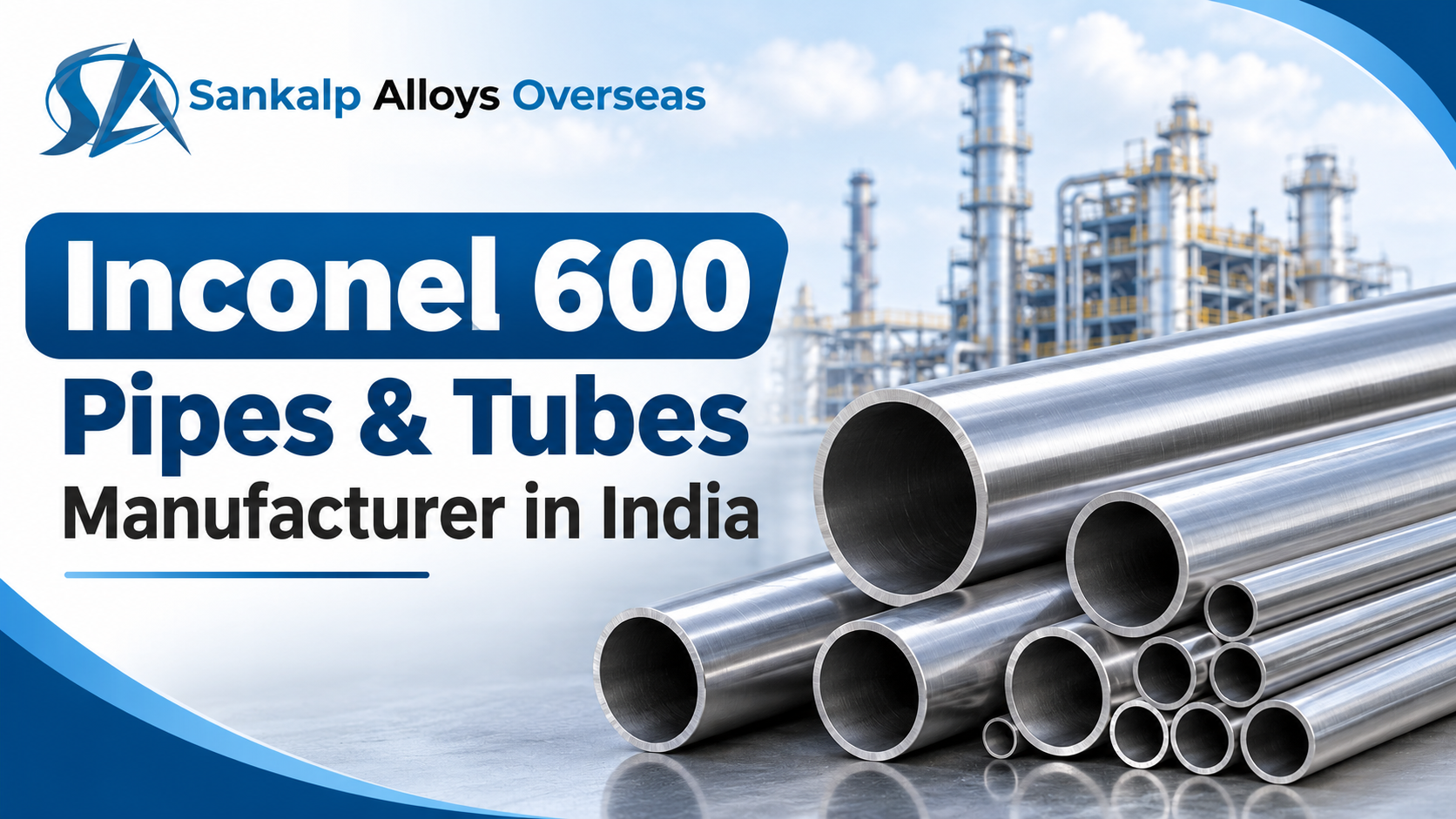
When sourcing from an Inconel 600 Pipes & Tubes Manufacturer in India, the first thing to settle is the exact product form and service condition. Inconel 600, also known as Alloy 600, is a nickel-chromium-iron alloy identified by UNS N06600 and Werkstoff number 2.4816. It is selected for a combination of oxidation resistance at elevated temperatures and resistance to several corrosive environments. Pipes and tubes are not interchangeable descriptions: their dimensions, applicable product standards and inspection requirements can differ. SankalPalloys can review an enquiry when the grade, dimensions, standard and operating conditions are clearly stated.
What is Inconel 600 pipe and tube?
Inconel 600 is a nickel-based alloy containing chromium and iron. Its high nickel content supports resistance in many reducing environments and to chloride-ion stress-corrosion cracking, while chromium contributes to oxidation resistance and performance in selected oxidising environments. It is used in equipment where ordinary carbon steel or stainless steel may not meet the required combination of temperature and corrosion performance.
The alloy is commonly identified as Alloy 600, UNS N06600, W.Nr. 2.4816 and EN designation NiCr15Fe. Inconel is a registered trademark; Alloy 600 is the material designation often used in technical and purchasing documents.
Are Inconel 600 pipes and tubes the same product?
Not necessarily. In many purchasing systems, pipe is ordered by nominal pipe size (NPS) and schedule, while tube is commonly ordered by exact outside diameter (OD) and wall thickness. Product standards also define different scope and requirements. A tube for a heat exchanger should not be quoted against a pipe specification simply because the alloy grade is the same.
Sticky Q&A — What is the grade number for Inconel 600? The UNS designation is N06600. The commonly referenced Werkstoff number is 2.4816. State the applicable ASTM or ASME material specification as well as the grade in your purchase enquiry.
Inconel 600 chemical composition and grade identification
Inconel 600 is a nickel-chromium-iron alloy. The following are commonly published composition limits in percent by mass. They are a quick reference, not a replacement for the limits and test requirements in the exact product specification and edition named on the purchase order.
| Element | Common composition requirement (% by mass) |
|---|---|
| Nickel (Ni), including cobalt where specified | 72.0 minimum |
| Chromium (Cr) | 14.0–17.0 |
| Iron (Fe) | 6.0–10.0 |
| Carbon (C) | 0.15 maximum |
| Manganese (Mn) | 1.00 maximum |
| Silicon (Si) | 0.50 maximum |
| Copper (Cu) | 0.50 maximum |
| Sulphur (S) | 0.015 maximum |
What makes Alloy 600 different from stainless steel 304 or 316?
Inconel 600 is a nickel-base alloy, whereas 304 and 316 are iron-base austenitic stainless steels. Alloy 600 is often considered when high-temperature oxidation behaviour, caustic environments or chloride stress-corrosion cracking are important design factors. That does not mean it is automatically the right choice for every chemical or temperature. Compare the actual corrosion data, design conditions, fabrication requirements and lifecycle cost before selecting it.
Buyer tip: Ask for a material test certificate (MTC) that identifies UNS N06600, the product specification, heat number and applicable test results. A label saying only “Inconel 600” is not enough to establish compliance with a specific order.
Types of Inconel 600 pipes and tubes
The manufacturing route and product form should match the service, dimensions and governing standard. The terms below are useful when preparing an enquiry, but the certificate and product marking should confirm what was actually supplied.
| Product form | Typical description | What to verify before purchase |
|---|---|---|
| Seamless pipe | Pipe manufactured without a longitudinal weld seam | ASTM B167 or other specified standard, NPS, schedule, heat treatment and test requirements |
| Seamless tube | Tube manufactured without a longitudinal weld seam | OD, wall thickness, length, tolerance and whether B163 or B167 is specified |
| Welded pipe | Pipe formed from alloy material and joined by a welding process | ASTM B517 where applicable, weld examination and supplementary project requirements |
| Welded tube | Tube made with a longitudinal welded seam | ASTM B516 where applicable, OD, wall, weld quality and testing |
| Heat-exchanger / condenser tube | Tube specified for heat-transfer equipment | ASTM B163 scope, exact dimensions, end finish, condition and inspection requirements |
Seamless or welded: which should a buyer choose?
Neither route is universally better. The choice depends on design code, pressure and temperature, tube or pipe dimensions, corrosion allowance, inspection requirements and the manufacturer's qualified process. Do not assume that “seamless” alone proves suitability, or that a welded product is unsuitable. Specify the required manufacturing route in the RFQ and verify it on the material documentation.
Inconel 600 pipe and tube sizes, dimensions and tolerances
There is no single size range that applies to every mill, product standard and manufacturing route. For pipe, provide NPS or outside diameter, schedule or specified wall thickness, and length. For tube, provide the exact OD × wall thickness, length and tolerance. Also state whether dimensions are in inches or millimetres to avoid conversion and rounding errors.
| RFQ field | Why it matters |
|---|---|
| Product form and manufacturing route | Separates pipe, tube, seamless and welded requirements |
| OD / NPS and wall thickness / schedule | Establishes the actual flow passage and pressure-wall dimensions |
| Length and end preparation | Helps plan fabrication, installation and cutting allowance |
| Dimensional tolerances | Controls fit-up and compliance with the ordered product standard |
| Delivery condition and heat treatment | Links the supplied condition to the specification and service |
| Inspection and test scope | Clarifies what evidence is required for acceptance |
Sticky Q&A — Can I order Inconel 600 tube by schedule? You can provide a schedule as a reference where it is meaningful, but tube enquiries are clearer when they state the exact outside diameter and wall thickness. Confirm the dimensional basis with the supplier and project specification.
Inconel 600 pipe and tube standards, certificates and inspection
Which ASTM standards are commonly specified for Alloy 600?
- ASTM B167 / ASME SB-167: Commonly specified for seamless nickel-chromium-iron alloy pipe and tube, including Alloy 600 within the standard's scope.
- ASTM B163 / ASME SB-163: Covers seamless nickel-alloy condenser and heat-exchanger tubes, including applicable Alloy 600 requirements.
- ASTM B516 / ASME SB-516: Commonly referenced for welded nickel-chromium-iron alloy tubes.
- ASTM B517 / ASME SB-517: Commonly referenced for welded nickel-chromium-iron alloy pipe.
- ASTM B829, B751 or B775: General-requirement standards that may apply when invoked by the relevant product specification or purchase order. Check the exact standard pairing rather than adding them automatically.
- Project specification and construction code: May add requirements for dimensions, heat treatment, NDE, pressure testing, traceability or third-party inspection.
What inspection documents should accompany Inconel 600 pipes and tubes?
Define the required documentation before placing the order. Depending on the product standard and project, this may include an MTC, heat-number traceability, chemical analysis, mechanical test results, dimensional inspection and required non-destructive or pressure tests. Positive material identification (PMI), third-party inspection and witness points should be written into the purchase order when required; they should not be assumed to be included in every standard supply.
Practical point: For a replacement tube bundle or an existing line, send the equipment drawing or old tube schedule if available. A photograph may help identify the general arrangement, but it cannot reliably establish OD, wall thickness, tolerance or alloy grade.
Applications of Inconel 600 pipes and tubes
Inconel 600 is considered for selected applications where oxidation resistance, elevated-temperature performance or resistance to particular corrosive media is needed. Common areas of use include:
- Heat exchangers and condensers: Tube applications where the fluid, temperature and design conditions are compatible with Alloy 600.
- Furnaces and heat-treatment equipment: Components exposed to elevated temperatures and oxidising conditions.
- Chemical processing: Equipment handling selected alkaline, caustic or other chemical process streams.
- Power and nuclear-related equipment: Specified components in systems where material selection is controlled by detailed codes and project approvals.
- Food and process equipment: Selected applications where the process chemistry, cleaning regime and regulatory requirements permit the alloy.
Is Inconel 600 resistant to every acid, chloride or high-temperature atmosphere?
No material is universally corrosion-proof. Alloy 600 has useful resistance in several environments, including many caustic conditions and chloride-ion stress-corrosion cracking scenarios, but performance depends on concentration, temperature, aeration, contaminants, stress and exposure time. Sulphur-bearing atmospheres and certain oxidising or halogen-containing environments need particular attention. Do not choose the alloy from a general “corrosion resistant” description alone; have the actual process conditions reviewed by a qualified materials or corrosion engineer.
Suggested technical-team quote for SankalPalloys (confirm wording with the team before publication): “With nickel alloy piping, the grade is only one part of the enquiry. We need to understand the medium, temperature, pressure and exact tube or pipe dimensions first; otherwise, two quotations may look similar while covering different requirements.”
How to request an Inconel 600 pipe and tube quotation in India
A useful RFQ gives every supplier the same technical basis. Include the following details wherever they apply:
- Material: Inconel 600 / Alloy 600 / UNS N06600.
- Product form: seamless pipe, seamless tube, welded pipe or welded tube.
- Applicable product standard and edition, such as ASTM B167, B163, B516 or B517 as appropriate.
- Pipe NPS and schedule, or tube OD and wall thickness; state units clearly.
- Required length, quantity, dimensional tolerances and end finish.
- Operating fluid, concentration, design pressure, design temperature and process conditions.
- Delivery condition, heat-treatment requirement and any supplementary testing.
- MTC, heat traceability, PMI, NDE, pressure test or third-party inspection requirements.
- Delivery location, required date, packing and commercial terms.
Four common Inconel 600 purchasing mistakes
1. Asking for “Inconel 600 pipe” without identifying the product standard or manufacturing route. 2. Giving a schedule when the application actually requires a precise tube OD and wall thickness. 3. Assuming every ASTM standard listed for Alloy 600 applies to every product form. 4. Comparing quotations without checking the MTC, heat treatment, testing, tolerances and delivery scope.
Sticky Q&A — What information helps a supplier quote accurately? Send the grade, product form, applicable standard, dimensions, quantity, service conditions and documentation requirements. A drawing or equipment datasheet is useful where dimensions are unusual.
If you have a pipe or tube schedule, contact SankalPalloys with the drawing, operating conditions and quantities. Ask for confirmation of the proposed product standard and the documents included in the offer.
FAQs about Inconel 600 pipes and tubes in India
What is the UNS number of Inconel 600?
Inconel 600, also called Alloy 600, has the UNS designation N06600. Its commonly referenced Werkstoff number is 2.4816.
Which ASTM standard is used for Inconel 600 seamless pipes?
ASTM B167 is commonly specified for seamless nickel-chromium-iron alloy pipe and tube, including Alloy 600 within its scope. Confirm the current edition and exact product requirements on the purchase order.
Which standard covers Inconel 600 heat exchanger tubes?
ASTM B163 covers seamless nickel-alloy condenser and heat-exchanger tubes. Check that the ordered grade, dimensions and testing requirements are included in the applicable edition.
What is the difference between ASTM B167, B163, B516 and B517?
They cover different product scopes: B167 is commonly used for seamless pipe and tube, B163 for seamless condenser and heat-exchanger tubes, B516 for welded tube and B517 for welded pipe. Select the standard according to the product form and project specification.
What is the chemical composition of Inconel 600?
Common limits include nickel 72% minimum, chromium 14–17%, iron 6–10%, carbon 0.15% maximum, manganese 1.00% maximum, silicon 0.50% maximum, copper 0.50% maximum and sulphur 0.015% maximum. The ordered specification and MTC govern acceptance.
Is Inconel 600 suitable for high-temperature service?
It is used in selected elevated-temperature applications, including furnace and heat-treatment equipment. Suitability depends on temperature, atmosphere, stress, design code and exposure conditions; use the applicable design data rather than a generic maximum-temperature claim.
What is the difference between Inconel 600 pipe and tube?
Pipe is commonly ordered by NPS and schedule, while tube is usually ordered by exact outside diameter and wall thickness. Their product standards and dimensional tolerances may also differ, so state the intended product form clearly.
What documents should I request when buying Inconel 600 pipes or tubes?
Specify the MTC and heat traceability, plus the dimensional, chemical and mechanical test results required by the product standard. Add PMI, NDE, pressure testing or third-party inspection only as required by the project and state them clearly in the RFQ.
Discuss your Inconel 600 pipe and tube requirements with SankalPalloys
Correct alloy identification is only the starting point. Matching the product standard, manufacturing route, dimensions and service conditions helps prevent specification gaps and fit-up issues. Send your Inconel 600 pipe or tube requirements, drawings, operating details and inspection scope to SankalPalloys for a clearly defined quotation enquiry.
Technical references
Use the latest applicable edition and the project specification when finalising a material order:
- Special Metals — manufacturer information for INCONEL® Alloy 600
- ASTM International — product standards including B163, B167, B516 and B517
- ASME — Boiler and Pressure Vessel Code and adopted material specifications
This article is general buyer guidance, not an engineering approval or a claim about SankalPalloys inventory, certifications, manufacturing capacity or lead time. Product-standard scope, chemistry, mechanical properties, dimensions and test requirements can vary by product form and edition. Confirm material compatibility, code requirements and the quoted scope before purchase.