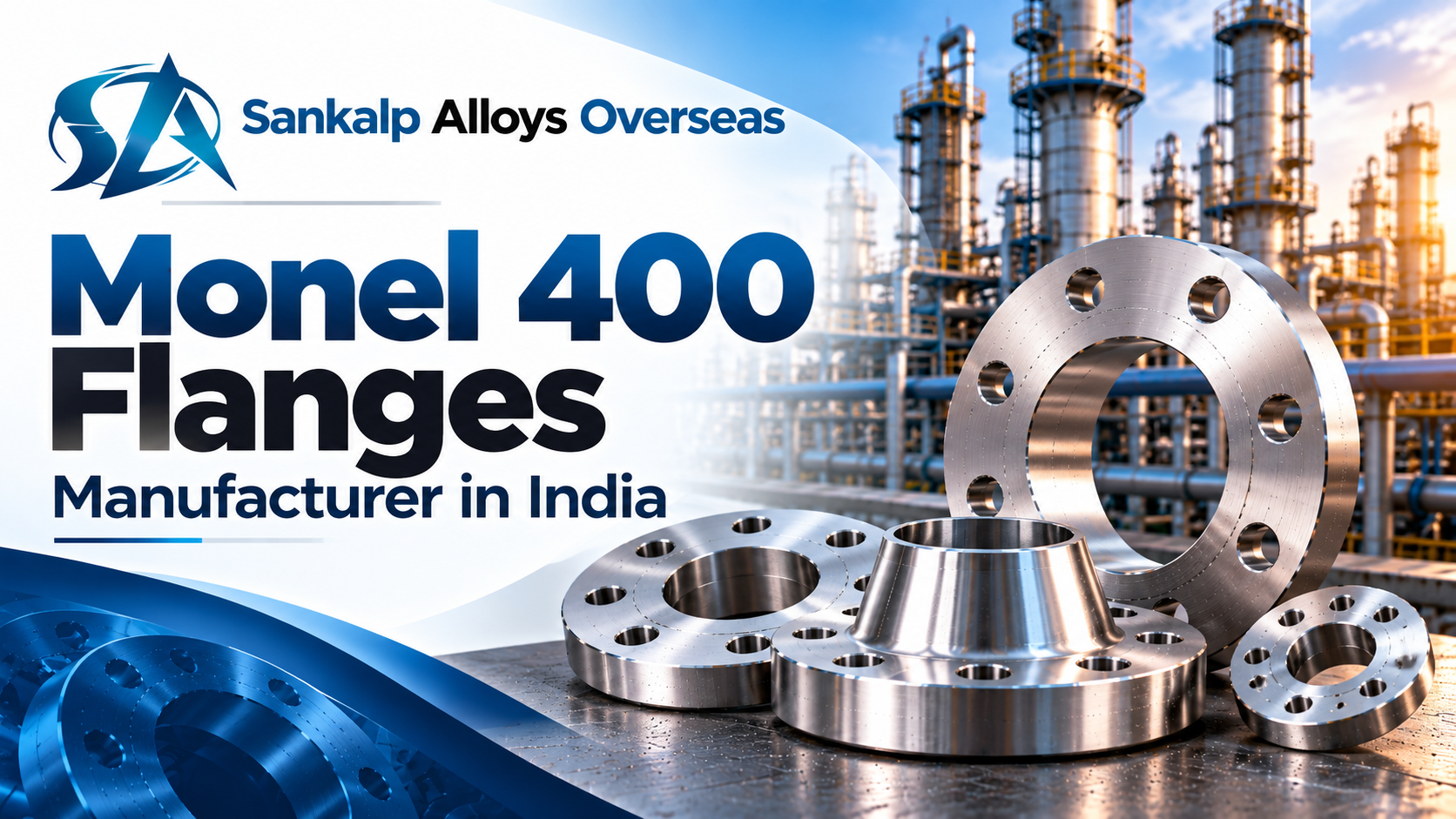
When sourcing from a Monel 400 Flanges Manufacturer in India, the important question is not simply whether a flange is made from a nickel alloy. Buyers need Alloy 400 / UNS N04400 in the right forging condition, dimensional standard, pressure class and facing for the actual line. This guide helps procurement and piping teams prepare a workable enquiry for SankalPalloys without leaving critical fit-up details to guesswork.
What is a Monel 400 flange, and when should it be specified?
A Monel 400 flange is a bolted piping connection made using Alloy 400 (UNS N04400), a solid-solution nickel-copper alloy. Engineers may specify it for suitably assessed seawater, saline, alkaline or chemical service. It is not a universal substitute for stainless steel: fluid chemistry, temperature and joint design still govern selection.
Are Monel 400 and Alloy 400 the same grade?
In material enquiries, Monel 400 refers to Alloy 400, identified by UNS N04400 and commonly linked to W.Nr. 2.4360 / 2.4361. MONEL is a trademarked alloy name; the UNS number is the practical grade identifier to place on purchase documents. It is different from Monel K-500 (UNS N05500).
Sticky Q&A — What do I confirm before requesting price? Start with UNS N04400 and the operating medium. Then verify type, standard, NPS/DN, class, facing and bore. A flange that has the right chemistry can still have the wrong bolt circle.
Monel 400 chemical composition and material identification
The following limiting composition values by weight are published in Special Metals' MONEL alloy 400 technical bulletin. They help identify the alloy; final acceptance depends on the purchase specification, product form, edition and material test certificate.
| Element | Published composition limit (wt. %) |
|---|---|
| Nickel (plus cobalt) | 63.0% minimum |
| Copper | 28.0–34.0% |
| Iron | 2.5% maximum |
| Manganese | 2.0% maximum |
| Carbon | 0.30% maximum |
| Silicon | 0.50% maximum |
| Sulfur | 0.024% maximum |
Buyer tip: Request heat-number traceability and the material test certificate (MTC) where the project requires them. Do not accept Monel K-500, generic “Monel” or a different nickel-copper grade as a silent substitution: the materials have different properties and specifications.
Monel 400 flange types: what should the buyer select?
Connection style depends on the piping drawing, joining method and governing code. These are common flange configurations buyers may enquire about; actual supply or manufacture for a given grade, size and class needs confirmation.
| Flange type | Typical purpose | What to verify |
|---|---|---|
| Weld neck | Butt-welded pipe connection | Bore, pipe schedule and weld-end preparation |
| Slip-on | Fillet-welded connection where permitted | Pipe clearance and weld detail |
| Blind | Closes a line or equipment opening | Thickness and design pressure/temperature |
| Socket weld | Specified small-bore service | Socket dimensions and assembly gap |
| Threaded | Approved non-welded connection | Thread type and service limitations |
| Lap joint | Loose backing flange with stub end | Stub-end geometry and wetted material |
Raised face (RF), flat face (FF) or ring-type joint (RTJ)?
Facing matters as much as the material grade. RF uses a raised gasket surface, FF uses a flat face and RTJ uses a specified ring groove. Match the mating flange and gasket arrangement rather than selecting a face from a product photograph.
ASME pressure classes and Monel 400 flange fit-up
ASME B16.5 covers specified pipe flanges and flanged fittings, with standard dimensions and pressure-temperature rating provisions within its scope. Familiar class designations are 150, 300, 400, 600, 900, 1500 and 2500. Material-group applicability, size limits and ratings must be verified for the relevant edition and project design.
| Specification item | Why it must be confirmed |
|---|---|
| Pressure class | A class label is not the allowable pressure at every temperature |
| NPS / DN | Determines nominal size and dimensional scope |
| Bore / pipe schedule | Controls compatibility with the specified pipe |
| Facing / gasket | Affects sealing and mating-joint compatibility |
Sticky Q&A — Does Class 300 mean 300 psi? No. Class 300 is a flange designation, not a fixed operating-pressure limit. Check the governing pressure-temperature rating and the complete bolted-joint design.
Monel 400 flange standards, tests and documentation
Which standards should appear in a Monel 400 RFQ?
- UNS N04400: The requested Alloy 400 material designation.
- ASTM B564: Nickel-alloy forgings specification that includes Alloy 400; check the applicable edition and product requirements.
- ASME SB-564: ASME-adopted forging specification when called for by the project.
- ASME B16.5: Standard flange dimensions and applicable rating rules within scope; confirm the material-group provisions.
- Approved drawings / project specifications: Special facings, tolerances, bore details and supplementary acceptance criteria.
What certificates and inspections should buyers ask for?
Depending on the contract, specify MTC, heat traceability, dimensional inspection, PMI (positive material identification), relevant NDT and third-party witnessing. State these requirements before quoting. Do not assume every Monel 400 flange automatically includes a particular certificate or inspection.
Practical point: When ordering for maintenance, send the installed mating flange's measured dimensions and marking details. “Same as existing” can hide an RF/FF mismatch or a nonstandard bore.
Where are Monel 400 flanges used, and what are the limitations?
Monel 400 is encountered in marine piping, seawater handling, salt-processing equipment, selected chemical and hydrocarbon processing, pumps, valves, heat exchangers and associated connections. Its nickel-copper composition gives useful resistance in many non-oxidizing environments, including certain alkalis and salt solutions.
Can Monel 400 handle any seawater or acid service?
No. Stagnant seawater, deposits, crevices, oxygen conditions and flow velocity can affect localized attack. Alloy 400 also should not be treated as suitable for strongly oxidizing acids such as nitric acid without an engineering assessment. Acid concentration and temperature matter; a generic “chemical resistant” label is not enough.
SankalPalloys technical-team quote — proposed wording for internal approval: “We prefer to see the fluid details and mating-flange drawing at enquiry stage. UNS N04400 tells us the alloy, but it does not tell us whether the complete joint is right for the line.”
How to send a useful Monel 400 flange RFQ in India
A complete enquiry reduces the back-and-forth between the design team, purchaser and supplier. Include:
- Material: Monel 400 / Alloy 400 / UNS N04400.
- Flange type, quantity and approved drawing, if applicable.
- Nominal size (NPS/DN), pipe schedule and bore.
- Dimensional standard, pressure class and RF/FF/RTJ facing.
- Applicable forging specification and required material condition.
- Process fluid, design temperature and pressure for suitability review.
- Certificates, heat traceability, PMI, NDT and inspection scope.
- Delivery destination, target date, packing and commercial terms.
Four common buying mistakes
1. Writing only “Monel flange” without UNS N04400. 2. Omitting the facing, bore or pipe schedule. 3. Treating Class 150/300 as a fixed pressure number. 4. Asking for an MTC, PMI or inspection witness only after the order is placed.
Sticky Q&A — How should two Monel 400 quotes be compared? Put both against the same grade, standard, drawing, inspection requirements, quantity and delivery basis. A low unit price may leave out testing or machining details.
For a project-specific enquiry, contact SankalPalloys with your drawing or bill of materials. Ask for written confirmation of product scope, availability and documentation.
FAQs: Monel 400 flanges in India
What is the UNS number for Monel 400 flanges?
Monel 400 (Alloy 400) is UNS N04400, a nickel-copper alloy. Include the UNS grade and material specification on the purchase order.
Is ASTM B564 used for Monel 400 forged flanges?
Yes. ASTM B564 covers specified nickel-alloy forgings, including UNS N04400. Flange geometry and ratings need separate dimensional/design requirements.
Which Monel 400 flange types can I ask about?
Enquiries commonly describe weld-neck, blind, slip-on, socket-weld, threaded or lap-joint designs. Confirm availability and compliance for the exact size, class and drawing.
Is Monel 400 suitable for seawater piping?
It is used in many marine applications, but suitability depends on flow, aeration, deposits, crevice design and operating conditions. Check the full service environment with an engineer.
Can Monel 400 be used in nitric acid service?
Generally, strongly oxidizing environments such as nitric acid are a poor choice for Alloy 400. Material selection must use service-specific corrosion data and engineering approval.
Is Monel 400 the same as Monel K-500?
No. Monel 400 is UNS N04400; precipitation-hardenable Monel K-500 is UNS N05500. They should not be interchanged without design approval.
What inspection documents should accompany an order?
Request the agreed MTC, heat traceability and dimensional report, plus PMI, NDT or third-party inspection where specified. Confirm certificate format before placing the order.
What details are needed for a Monel 400 flange quotation?
Provide UNS N04400, type, size, bore, standard, class, facing, quantity, inspection scope, delivery location and drawing if special machining is required.
Discuss Monel 400 flange requirements with SankalPalloys
Share your UNS N04400 requirement, flange drawing, class, facing, bore, quantity and inspection needs. Contact SankalPalloys to confirm the technical scope, quotation and delivery details before purchase.
Technical references
For material identification and purchasing checks, verify the current edition and project requirements using these original references:
- Special Metals — MONEL alloy 400 technical bulletin
- ASME B16.5 — Pipe Flanges and Flanged Fittings
- ASTM B564 — Standard Specification for Nickel Alloy Forgings
This article provides general purchasing guidance, not engineering approval or confirmation of stock, manufacturing capability or availability for a specific order. Verify engineering suitability, applicable editions, documentation and commercial terms before ordering.