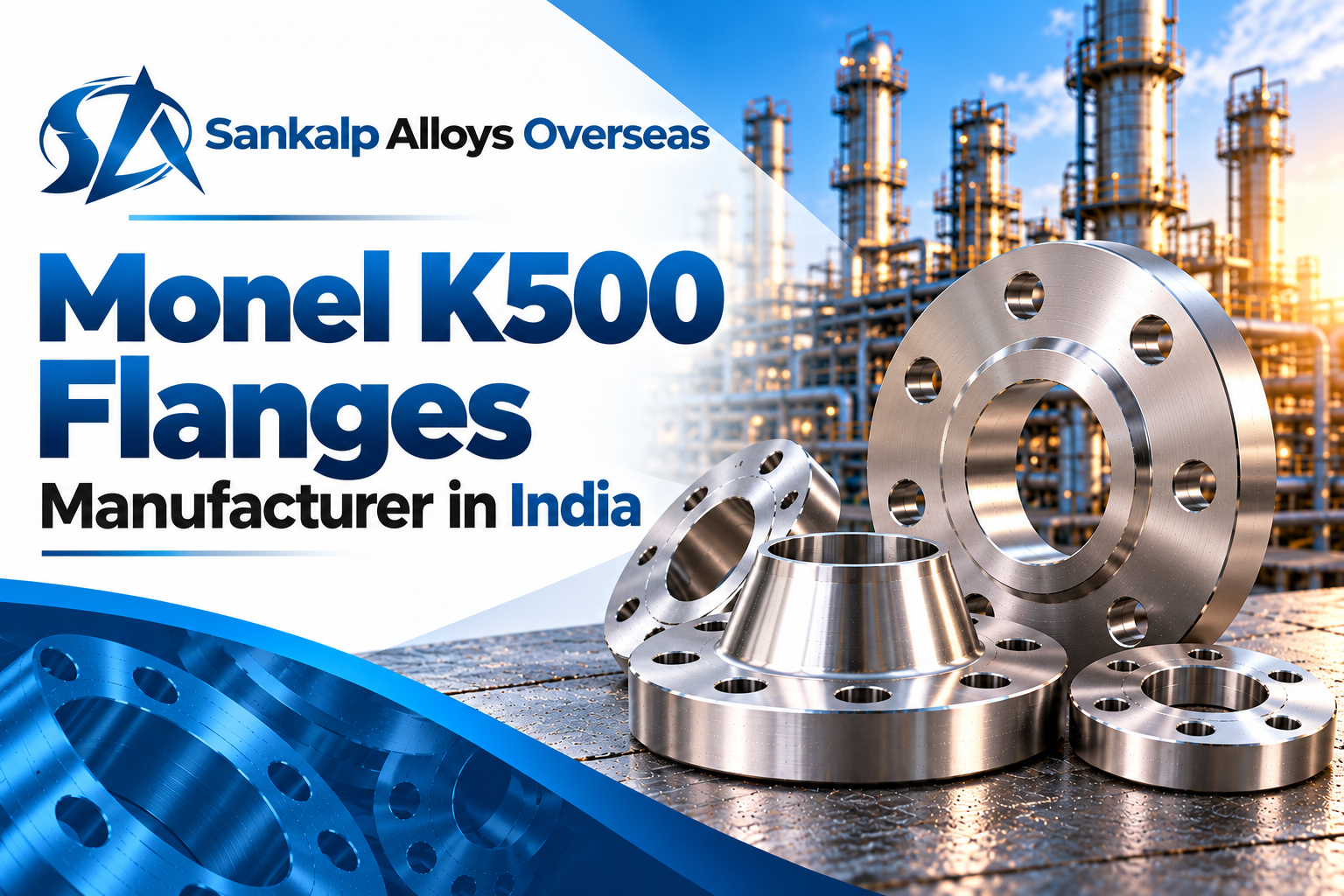
Searching for a Monel K500 Flanges Manufacturer in India? Begin with the grade, service environment and flange drawing—not the price per piece. Monel alloy K-500 (UNS N05500) is a nickel-copper alloy strengthened by controlled age hardening. It is considered for demanding marine, pump, valve and selected oil-and-gas applications when both corrosion resistance and strength matter. Send SankalPalloys your specifications for a technical and commercial enquiry rather than assuming every size or heat-treated condition is available.
What is a Monel K500 flange, and why is this grade used?
A Monel K500 flange connects pipework, valves, pumps or equipment where UNS N05500 is specified. It belongs to the nickel-copper family and is related to Alloy 400, but the aluminium and titanium additions allow precipitation hardening. This can improve strength and hardness while retaining useful corrosion resistance in many environments.
Is Monel K500 the same as Monel 400?
No. Monel 400 is UNS N04400; Monel K500 is UNS N05500, also identified as W.Nr. 2.4375. They are not interchangeable just because both are nickel-copper alloys. Specify the correct grade and heat-treated condition.
Sticky Q&A — What should be checked first? Establish the fluid, temperature, pressure and mating connection. Then confirm the required K500 condition, flange dimensions, facing, bore and inspection scope. If a drawing omits the condition, ask before procurement.
Monel K500 chemical composition and heat-treatment checks
These are published nominal chemistry limits for Monel alloy K-500 by weight, using Special Metals technical information. They are not a substitute for the applicable purchase specification and the actual heat's material test certificate.
| Element | Published range / limit (% by weight) |
|---|---|
| Nickel + cobalt (Ni + Co) | 63.0 minimum |
| Copper (Cu) | 27.0–33.0 |
| Aluminium (Al) | 2.30–3.15 |
| Titanium (Ti) | 0.35–0.85 |
| Iron (Fe) | 2.0 maximum |
| Manganese (Mn) | 1.5 maximum |
| Silicon (Si) | 0.5 maximum |
| Carbon (C) | 0.25 maximum |
| Sulphur (S) | 0.01 maximum |
Why does age hardening matter for a flange order?
K500 develops increased strength through a controlled thermal process that forms fine precipitates in the alloy. Mechanical properties therefore depend on the supplied condition and processing history—not on chemistry alone. Request the relevant heat-treatment record and mechanical test results when the specification requires them.
Buyer tip: A test certificate showing UNS N05500 chemistry is useful, but does not by itself establish the agreed aged condition, dimensional conformity or design rating. Keep those checks separate.
Types of Monel K500 flanges and connection details
Flange type selection follows the piping design, installation method and project code. The options below describe common connection geometries, not a claim that each type is stocked or manufactured in K500.
| Flange type | Typical connection | Check before ordering |
|---|---|---|
| Weld neck | Butt-welded piping connection | Bore, hub, pipe schedule and qualified welding procedure |
| Slip-on | Fillet-welded joint, if permitted | Weld details and application limitations |
| Blind | Closure at pipe or equipment end | Thickness, loads and pressure-temperature design |
| Socket weld | Specified small-bore connection | Socket dimensions and installation clearance |
| Threaded | Threaded service where allowed | Thread form and suitability for service |
| Lap joint | Backing flange with compatible stub end | Stub-end material, face and geometry |
RF, FF or RTJ: which flange facing is suitable?
RF is raised face, FF flat face and RTJ ring-type joint. Specify the facing required by the mating flange, gasket and joint design. A matching bolt pattern by itself does not ensure a leak-tight connection.
Monel K500 flange pressure classes, dimensions and bore
ASME B16.5 provides flange dimensions and pressure-temperature rating rules within its scope, but do not assume UNS N05500 has an assigned rating under every edition or material group. An engineer must establish the applicable code basis and approved rating for the specified material and condition. Common class designations are 150, 300, 400, 600, 900, 1500 and 2500; these are not fixed pressure values.
| RFQ detail | Why buyers should specify it |
|---|---|
| Design pressure and temperature | Needed to check the approved joint and material rating |
| NPS / DN and dimensional standard | Controls diameter and bolt-hole pattern |
| Bore / pipe schedule | Controls pipe match and weld preparation |
| Facing and gasket | Must match the joint design and mating flange |
Sticky Q&A — Does Class 300 mean 300 psi? No. Class 300 is a flange class designation, not a universal allowable operating pressure. Service pressure depends on the approved standard, material, temperature and connection design.
Monel K500 flange standards, verification and documentation
Which standard should be stated in a Monel K500 flange enquiry?
- UNS N05500 / W.Nr. 2.4375: Identifies the K500 alloy, not a complete flange purchase specification.
- Material/forging specification: Confirm a specification that actually covers the requested UNS N05500 product form and condition, agreed with the project engineer.
- ASTM B865 / AMS 4676: May appear in K500 bar or rod references; do not automatically treat bar-stock specifications as approval for finished flanges.
- ASTM B564: Frequently cited for other nickel-alloy forgings, but UNS N05500 is not listed in the published ASTM B564-25 scope; do not specify it for K500 without verifying a genuinely applicable requirement.
- ASME B16.5: Use for flange geometry where applicable, subject to an approved material and pressure-temperature design basis.
- Project drawing and piping code: Control bore, tolerances, machining, joint design, inspection and acceptance.
What material and inspection documents matter?
Request a material test certificate (MTC) with heat traceability, chemistry and required mechanical properties. If project documents require positive material identification (PMI), dimensional inspection, ultrasonic testing, NDT, third-party witnessing or heat-treatment records, put those items in the RFQ and purchase order.
Practical point: A replacement flange is not correctly specified by a photograph alone. Ask for the existing standard, drawing, bolt pattern, bore and facing before requesting machining.
Where are Monel K500 flanges considered for industrial use?
Monel K500 is used in demanding marine equipment, pump and valve components, offshore and selected oil-and-gas equipment, and chemical-processing assemblies. For a flange specifically, the choice must be justified by the system's fluid, corrosion exposure, strength needs and compatible joint design rather than by the alloy's reputation alone.
What are the corrosion and service limitations?
K500 has corrosion behaviour broadly similar to Alloy 400 in many media, but age-hardened K500 can be more susceptible to stress-corrosion cracking in certain environments. Seawater velocity, stagnation, fouling, temperature and mixed chemicals also matter. Sour-service suitability requires evaluation against the applicable specification and actual conditions; a blanket "sour-service approved" claim is not enough.
Suggested technical-team perspective for SankalPalloys (approve wording before attribution): “A K500 enquiry is easier to evaluate when the drawing and heat-treated condition come together. Two parts marked UNS N05500 can still need very different checks.”
How to request a Monel K500 flange quotation in India
A useful request for quotation (RFQ) lets the technical team compare the same scope across offers. Include:
- Material: Monel K500 / UNS N05500, with the approved product-form specification.
- Required supply condition, age-hardening requirements and mechanical acceptance criteria.
- Flange type, quantity and approved fabrication or machining drawing.
- NPS / DN, bore, pipe schedule, facing and mating-flange information.
- Approved dimensional standard, class or engineered rating basis.
- Design pressure, temperature, medium and any special corrosion or sour-service conditions.
- MTC, heat traceability, PMI, testing, inspection and witness requirements.
- Required delivery date, destination, packing and quotation terms.
Four mistakes that can delay a K500 flange order
1. Treating Monel 400 and K500 as interchangeable. 2. Leaving the age-hardened condition undefined. 3. Quoting a generic ASTM forging specification without confirming UNS N05500 is in scope. 4. Comparing prices without checking the same bore, facing, testing and documentation.
Sticky Q&A — How should two quotations be compared? Match grade, condition, exact drawings, rating basis, inspection scope, certificate requirements, quantity and commercial terms. A low price is not comparable if key tests or machining are excluded.
For a project requirement, contact SankalPalloys with the bill of materials and drawings, and ask which specifications and delivery terms can be quoted.
FAQs about Monel K500 flanges in India
What is the UNS grade of Monel K500?
Monel K500 is UNS N05500 (also W.Nr. 2.4375), an age-hardenable nickel-copper alloy with aluminium and titanium additions.
What is the difference between Monel K500 and Monel 400?
K500 (UNS N05500) can be precipitation hardened for higher strength and hardness. Monel 400 (UNS N04400) does not use the same age-hardening mechanism. They should not be substituted without engineering review.
Which ASTM specification should I use for K500 flanges?
Specify an approved product-form and forging specification that actually includes UNS N05500. ASTM B564-25 does not list N05500 in its published scope; confirm the correct specification with the project engineer.
Can Monel K500 flanges be used in seawater service?
K500 is considered for certain marine applications, but suitability depends on velocity, stagnation, fouling, temperature, joint design and the actual alloy condition. Obtain service-specific approval.
Does Class 150 or 300 specify the working pressure of K500?
No. Flange class labels are not fixed working-pressure values. Use the approved material rating, relevant standard and design temperature to establish the pressure limit.
Why should the K500 heat-treated condition be stated?
Age hardening affects mechanical properties and may affect service performance. Specify the required condition and supporting heat-treatment or test records instead of relying on grade chemistry alone.
Which tests and certificates should I request?
Ask for an MTC with heat traceability and the specified mechanical and chemical results. State PMI, NDT, dimensions and third-party inspection in the order where required.
What information is needed for a Monel K500 flange quotation?
Share UNS N05500, type, quantity, drawing, size, bore, face, material condition, approved standard and rating basis, design conditions, inspection needs and delivery details.
Discuss your Monel K500 flange requirements with SankalPalloys
There is no single specification that makes every K500 flange suitable for every plant. Share your UNS N05500 requirement, required condition, flange drawing, size, facing, rating basis and inspection scope. Contact SankalPalloys to discuss the available technical and commercial options for your application.
Technical references
Use the current standards and alloy-producer literature when finalising the material and flange specification:
- Special Metals — MONEL alloy K-500 (UNS N05500) technical bulletin
- ASME B16.5 — Pipe Flanges and Flanged Fittings
- ASTM B564-25 — Published scope for nickel alloy forgings (check included UNS grades)
This guide provides general procurement information, not engineering approval or a claim about SankalPalloys stock, manufacturing processes, certifications or lead times. Verify the approved material standard, product condition, rating and quotation details before ordering.