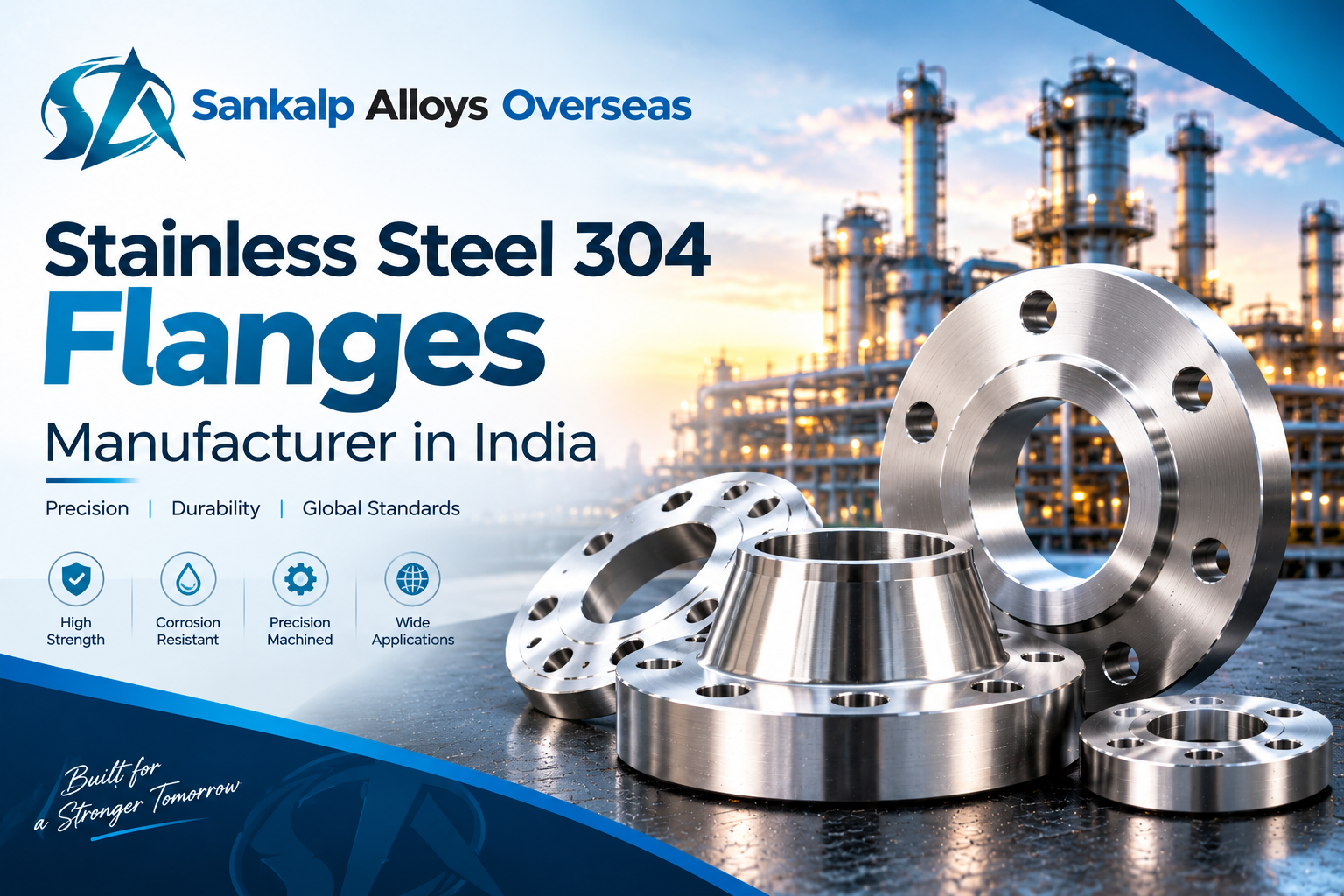
If you're comparing a Stainless Steel 304 Flanges Manufacturer in India, a useful quotation starts with the actual connection, not only a grade and price. SS 304 (UNS S30400) is a chromium-nickel austenitic stainless steel often specified for piping and equipment in general industrial service. For forged flanges, buyers commonly refer to ASTM A182 Grade F304. But grade alone does not settle the bore, pressure class, facing, gasket, inspection or suitability for the process fluid. SankalPalloys can review a clearly defined flange enquiry against the requested scope.
What is a Stainless Steel 304 flange?
A stainless steel 304 flange is a detachable piping connection made using Grade 304 stainless steel. It allows a pipe to connect to a valve, pump, vessel nozzle or another pipe through bolting and an appropriate gasket. Grade 304 is an austenitic chromium-nickel stainless steel, identified as UNS S30400 and commonly associated with EN material number 1.4301.
Are SS 304 and ASTM A182 F304 the same thing?
SS 304 identifies an alloy grade; ASTM A182 F304 identifies a grade supplied to a particular forged or rolled piping-component specification. A flange quote should name both the required material specification and the dimensional standard. A generic “304 flange” description leaves too much open to interpretation.
Sticky Q&A — What should a first-time buyer specify? At minimum: ASTM A182 F304 where applicable, flange type, NPS/DN, class, facing, bore or pipe schedule, quantity and intended service.
SS 304 chemical composition and grade identification
Grade 304 is often described as 18/8 stainless steel because its nominal chemistry centres on chromium and nickel. The figures below are commonly specified composition limits for UNS S30400, in percent by mass; confirm the applicable edition of the ordered material standard and the supplied heat's material test certificate (MTC).
| Element | Typical specification limit (% by mass) |
|---|---|
| Chromium (Cr) | 18.0–20.0 |
| Nickel (Ni) | 8.0–11.0 |
| Carbon (C) | 0.08 maximum |
| Manganese (Mn) | 2.00 maximum |
| Silicon (Si) | 1.00 maximum |
| Phosphorus (P) | 0.045 maximum |
| Sulphur (S) | 0.030 maximum |
| Iron (Fe) | Balance |
SS 304 versus SS 304L: what changes for a flange?
304L (UNS S30403) is the lower-carbon variant, usually specified with a maximum carbon content of 0.03%. It can be preferred where welding and resistance to weld-related sensitisation matter. F304 and F304L are not automatic substitutes: compare the approved piping specification, mechanical requirements, temperature and certificate before changing the ordered grade.
Buyer tip: Request the heat number and MTC alongside the declared grade. A shop description such as “18/8” is useful shorthand, not a substitute for chemical and mechanical acceptance criteria.
Types of Stainless Steel 304 flanges and their connections
The right flange type depends on the joint design, pipe size, pressure conditions and installation method. Confirm the requested type against the applicable piping code and the actual product drawing.
| Flange type | Typical connection | What to verify before purchase |
|---|---|---|
| Weld neck | Butt-welded connection with tapered hub | Flange bore, pipe schedule and weld preparation |
| Slip-on | Pipe passes into flange; fillet welds where permitted | Pipe outside diameter, welding scope and service restrictions |
| Blind | Closes a pipe or equipment opening | Thickness, design pressure and facing |
| Socket weld | Small-bore pipe fitted into a socket | Socket details, installation clearance and code suitability |
| Threaded | Screwed connection without a flange-to-pipe weld | Thread standard, sealing method and permitted service |
| Lap joint | Loose flange used with a suitable stub end | Stub-end grade, dimensions and rotating fit |
Raised face, flat face or ring-type joint?
RF (raised face), FF (flat face) and RTJ (ring-type joint) describe different gasket-contact arrangements. The flange face must suit the mating flange, gasket and bolting design. Matching bolt holes alone does not make two flanges interchangeable.
SS 304 flange sizes, pressure classes and dimensional fit
ASME B16.5 addresses applicable flanges in NPS 1/2 through NPS 24 for Classes 150, 300, 400, 600, 900 and 1500; Class 2500 is covered through NPS 12. Exact scope, material group and pressure-temperature ratings must be checked against the applicable edition. Do not use a class number as a direct psi figure. Larger or nonstandard flanges need a separately verified dimensional and design basis.
| RFQ field | Why it matters |
|---|---|
| NPS / DN and class | Determines the specified size and rating family |
| Flange type, pipe OD and schedule | Prevents bore and welding-fit errors |
| RF / FF / RTJ, surface finish | Controls gasket and mating-face compatibility |
| Bolt pattern and flange standard | Helps verify joint assembly and replacement fit |
Sticky Q&A — Does Class 150 mean 150 psi at every temperature? No. It is a pressure-class designation. The allowable pressure depends on material group, temperature and the governing standard.
SS 304 flange standards, certificates and inspection
Which standards belong in an SS 304 flange purchase order?
- ASTM A182/A182M Grade F304: Material requirements for applicable forged or rolled stainless steel piping components, including flanges.
- UNS S30400: Alloy identifier for conventional Grade 304 stainless steel.
- ASME SA-182: ASME-adopted material specification when required by the construction code or approved project documents.
- ASME B16.5: Applicable flange dimensions, tolerances, pressure-temperature ratings, marking and joint requirements.
- Project piping specification: Controls any extra bore, surface-finish, weld, inspection or traceability requirements.
What inspection documents should you ask for?
Specify the MTC, heat-number traceability, dimensional report and any required PMI (positive material identification). Additional non-destructive testing, surface checks or third-party inspection should be explicitly included if the project requires them. The phrase “tested flange” is too vague unless the test scope is stated.
Practical point: For a shutdown replacement, send the existing flange drawing or a dimensioned sample report. A photo may show the general type, but not reliably the face finish, bore or drilling standard.
Where are Stainless Steel 304 flanges used, and where should buyers be cautious?
Grade 304 flanges are considered for water-treatment equipment, food and beverage process lines, general chemical equipment, utilities, HVAC connections and other industrial piping where the fluid, cleaning conditions and design code permit the alloy. Their chromium-rich passive surface helps resist corrosion in many ordinary environments.
Is SS 304 suitable for seawater, concentrated chlorides or every chemical?
No. Chloride-rich service can cause pitting, crevice corrosion or stress-corrosion cracking, especially under unfavourable temperatures and deposits. A project may need another material, such as 316L or a higher-alloy grade, but that decision needs a corrosion and design review. A higher grade name alone also does not guarantee suitability.
Suggested technical-team quote for SankalPalloys (approve before attributing): “Most flange mismatches we try to prevent are straightforward: the buyer gives the grade but leaves out the bore, face or service temperature. Those small details often matter more than another round of price comparison.”
How to request an SS 304 flange quotation in India
Send one complete RFQ so different offers can be compared against the same requirements:
- Material: ASTM A182 F304 / UNS S30400, or the actual approved project grade.
- Flange type, required quantity and applicable drawing or bill of materials.
- NPS/DN, pressure class, flange standard and mating connection.
- Pipe schedule, bore, weld-end details and facing (RF, FF or RTJ).
- Service fluid, design pressure, design temperature and cleaning conditions.
- Requested surface finish, tolerances and any special project requirements.
- MTC, heat identification, PMI, inspection or witness requirements.
- Delivery destination, required date and commercial terms.
Four common SS 304 flange buying mistakes
1. Asking for “304 flange” without a material and dimensional standard. 2. Assuming a Class 300 flange is rated for exactly 300 psi. 3. Ignoring chloride exposure, gasket facing or bore compatibility. 4. Comparing one quote with an MTC and PMI scope against another without them.
Sticky Q&A — How can I compare suppliers fairly? Ask each supplier to quote the same grade, dimensions, inspection scope, packing and delivery basis. If a line item is excluded, note it before comparing price.
If you have a flange schedule, contact SankalPalloys with the drawing, operating conditions and quantities. Request clear confirmation of what the quotation includes.
FAQs about Stainless Steel 304 flanges in India
What is the material grade for forged SS 304 flanges?
Buyers commonly specify ASTM A182 Grade F304, with the alloy identified as UNS S30400. Confirm the governing code and material specification before purchasing.
Which dimensional standard is used for SS 304 pipe flanges?
ASME B16.5 is widely used for applicable pipe flange dimensions and pressure-temperature ratings. Other standards may apply to a particular project or connection.
What is the difference between SS 304 and SS 304L flanges?
304L has a lower specified maximum carbon content and is often considered for welded service. Do not substitute F304L for F304 without confirming project acceptance and material requirements.
Which SS 304 flange types can I request?
Common types include weld neck, slip-on, blind, socket weld, threaded and lap joint. The suitable type depends on the piping design, size, service and applicable standard.
Are SS 304 flanges suitable for seawater?
Do not assume so. Seawater and other chloride-rich environments can cause localised corrosion in 304. Request a material suitability review for the actual exposure conditions.
Does Class 600 mean a 600 psi working-pressure limit?
No. Flange class is a designation, and the allowable pressure depends on temperature, material group and the applicable pressure-temperature tables.
What documents should accompany SS 304 flanges?
Specify an MTC and heat traceability when needed. Add dimensional inspection, PMI or third-party inspection explicitly if the purchase specification requires them.
What information is needed for an SS 304 flange price enquiry?
Share material specification, flange type, nominal size, class, facing, bore, quantity, operating service, documentation needs and delivery destination.
Discuss your Stainless Steel 304 flange requirements with SankalPalloys
Correct grade selection is just the starting point. Matching dimensions, service conditions and certificate requirements helps avoid costly fit-up problems. Send your SS 304 flange list, drawings, service details and inspection scope to SankalPalloys for a clearly defined quotation enquiry.
Technical references
Verify the latest applicable edition and project requirements before finalising a flange specification:
- ASTM A182/A182M — Forged or Rolled Alloy and Stainless Steel Pipe Flanges
- ASME B16.5 — Pipe Flanges and Flanged Fittings
- worldstainless — Stainless steel material and corrosion guidance
This article is general buyer guidance, not an engineering approval or a claim about SankalPalloys inventory, certifications, manufacturing capacity or lead time. Confirm material compatibility, code requirements and the quoted scope before purchase.